
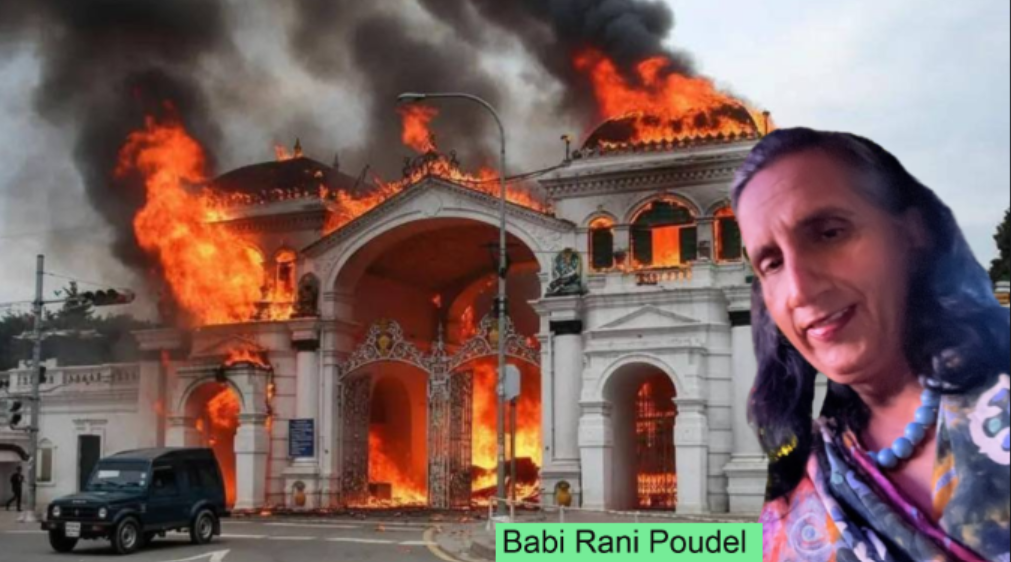
I am Babi Rani Poudel — a proud daughter of Nepal, now living and working in Melbourne, Australia. I am an LGBTQIA+ activist, a passionate health advocate, and a support worker devoted to those most overlooked by society. From people living with HIV to displaced communities, from queer youth to forgotten elders, I dedicate my voice and life to those still struggling to be heard. But today, I write not just as an activist — I write as a witness. As a child of Nepal, I watch in grief as my homeland is set ablaze — not only by fire, but by anger, by despair, by a slow-burning collapse of trust, unity, and morality.
“You can burn the building, but not the memory of what it once stood for. You can burn the road, but not the path we must still walk.” These words ring louder each day. All across Nepal, buildings are torched, streets are blocked, health posts vandalized. The air smells of smoke, not just from fire, but from frustration. But amid the ashes, I ask — what did we really destroy? Not just stone and steel — we destroyed hope. Not just offices — we burned away trust. We say we want change. We demand justice. But can justice grow from destruction? Can a future be born from the funeral of our own institutions?
Each time a protest turns violent, it is the innocent who suffer. When a school is set on fire, a child loses her dreams. When a rural health post is burned down, a mother dies in labor, unseen. When roads are closed for days, a farmer’s produce rots before it ever reaches the market. A patient dies in the back of an ambulance. A student misses their exams. A laborer loses their daily wage. A grandmother walks for miles because the bus cannot pass. So again — who are we really fighting? The system? Or ourselves?
We forget that government buildings are not mansions of the elite — they are built with the blood, sweat, and labor of everyday people. With the remittance of fathers working in the Gulf. With the unpaid care of mothers raising children alone. With the sweat of farmers, teachers, and workers. When we burn a ward office, we are not punishing the corrupt — we are punishing the poor. Inside that office are your land records, your ID, your grandmother’s pension file, your sibling’s scholarship form. That desk may hold a bureaucrat’s pen, but the paper is ours. We demand reform — but reform doesn’t grow in rubble. It grows in responsibility.
Our nation has never lacked revolution. We’ve lived through the Sugauli Treaty, the Kot Massacre, the People’s Movement of 2007, the democratic waves of 2046, the Maoist insurgency, and more. We tore down thrones, embraced republics, and watched governments fall like dominoes. Yet somehow, poverty stayed. Education remained a privilege. Jobs disappeared. And justice? Still just a word in speeches. We rotate leaders, we recycle slogans — but do we ever transform ourselves? We’re not just burning buildings. We’re burning lessons. And still, the past repeats.
Look at the world. Japan rose from nuclear ashes. Germany rebuilt from genocide. South Korea, once poorer than Nepal, is now a global leader in technology and education. They didn’t waste time burning — they built. They turned pain into purpose, not protests. They educated their children, paved their roads, and brought their diaspora home not to serve others — but to lead their own. What do they have that we don’t? Not more brains. Not more money. They had vision. Discipline. A shared goal. We have emotion — but without direction, emotion becomes destruction.
And yes, corruption is real. It lives in ministries and mansions. But let’s be honest — it lives in our homes too. In the bribes we pay to fast-track a passport. In the donation demanded by private schools. In the “extra charges” at hospitals. Corruption is not just top-down — it’s inside our culture. We say, “The system is broken.” But have we ever asked ourselves: “What have I done to fix it?” Change begins not at Singha Durbar — but at our own front door.
When you burn a clinic, it’s not the Health Minister who suffers. It’s the mother in labor, the child with fever, the elderly man who walked two days for insulin. When you destroy a bus, it’s not the CEO who suffers — it’s the student who misses class, the maid who loses her job, the family that goes hungry. This is not revolution. This is self-harm. Real revolution builds — with courage, with ideas, with discipline.
Today, we are not at war with kings. We are at war with ignorance. With apathy. With our own lack of patience. We post outrage, but don’t vote. We scroll TikTok, but don’t read books. We quote Mandela and MLK, but ignore our own grandmothers. We rage online, but forget to ask ourselves: What are we really doing? Passion without purpose is chaos. Anger without action is just noise.
And in that noise, it’s always the most vulnerable who are silenced first. When programs are shut down, HIV testing disappears. LGBTQIA+ lives are put at risk. Rural youth lose safe spaces. Indigenous voices are drowned in slogans that were never theirs to begin with. Organizations like UNAIDS leave — not because their mission is done — but because we failed to protect their space. A nation that steps over its most fragile to shout louder will never rise. We rise together, or we do not rise at all.
Even here in Australia, I see the storm follow us. Anti-immigration protests rise. Migrants — Nepalis among them — are deported, detained, discriminated against. Once, we left Nepal to chase opportunity. Now, we flee just to breathe freely. But ask yourself: if Nepal had dignity, equality, justice — would we leave at all? We sent our youth abroad not with platforms, but with passports. They didn’t go for dreams — they went to survive.
So before you light the next fire, think: What will I destroy? A document someone waited years for. A vaccine a child needs. A road a student must take. Every flame scorches the future. Every stone aimed in rage bruises an innocent soul. Instead, ask: What seed can I plant here? What path can I build?
Nepal doesn’t need more rebels. It needs reformers. Builders. Teachers. Voters. Health workers.
Leaders. If even half our angry youth picked up tools instead of torches, we would rebuild this nation within a generation. We have enough pain. What we need now is purpose.
Nepal is not just a piece of land. It’s not just a flag or a constitution. Nepal is you. It is your courage, your choices, your integrity. You may not trust the system — but the system watches you too.
“Arko ko lahilahi ma nalagnu, dukkha paunuparcha.”
(Don’t follow others blindly — or you’ll suffer the consequences.)
“Fal khanu, butonachinanu.”
(Don’t expect fruit if you don’t know the path.)
“Buddhi le aru kha, ris le afu kha.”
(Wisdom feeds others. Rage devours the self.)
We say Nepal is the land of Buddha. Then why are we burning it? Why do we choose violence, if we claim to follow peace? We bow before Sita’s purity, yet degrade women on the streets. Our schools taught us moral science — where is our morality now? Death is not new in Nepal. We’ve lost lands like Kalapani and Tista — but more painfully, we’ve lost lives. We’ve lost dignity.
My own Arami brother died while serving in a UN peacekeeping mission during the Second World War. Others died in 2007, in 2046, in the Maoist insurgency. Still we have not learned. We are repeating history, expecting different results.
I may not be able to become a father. I cannot become a mother either. But around me, I have 50 children who call me family. They love, they trust, they hope. That’s enough to know the power of compassion. And that is enough to remind us: children are watching. What we say, what we write, what we post — they see it all.
When a child scrolls their mother’s phone and sees burning tires, bleeding faces, and hateful posts — what do we think it does to their mind? To their heart? What trauma are we passing down in the name of protest?
Social media is not a battlefield. It is not your stage. Be a responsible user. Think before you post. Think not of your image — but of the impact on someone vulnerable, someone suffering with PTSD, someone young, confused, scared.
Let us stop burning what we love. Let us build it. Let us be the peace we preach. And maybe, just maybe — the day we stop shouting, and start listening, will be the day Nepal begins to truly rise.
By Babi Rani Poudel – LGBTQIA+ Activist, Health Advocate, and Support Worker for Marginalized Communities. Born in Nepal, Residing in Melbourne, Australia.

Copyright © All right reserved to pahichan.com Site By: Sobij.
