
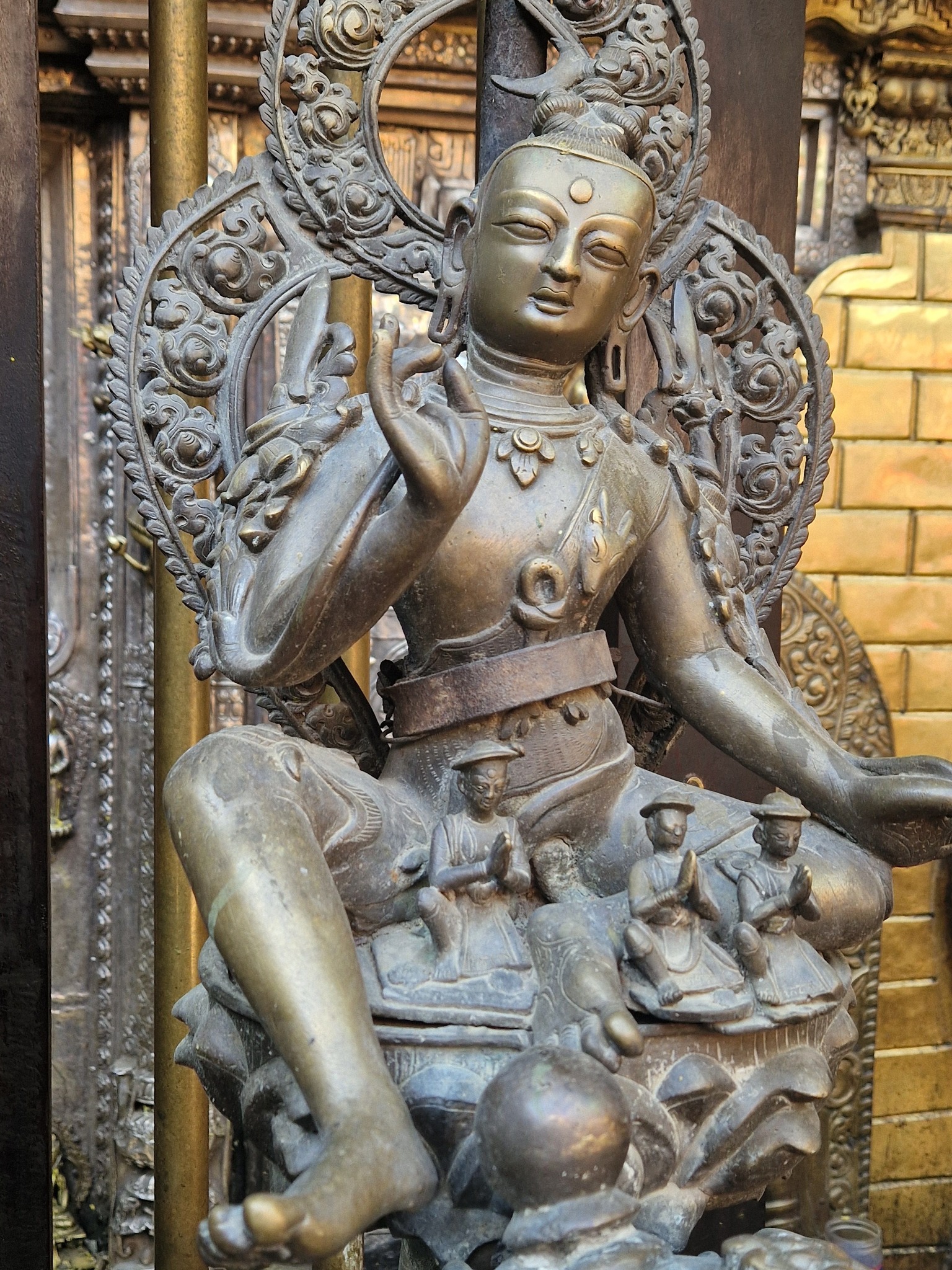
Human beings are often celebrated as the most “intelligent” animals on Earth. Artificial Intelligence, too, is built on this same faculty—intelligence. Yet intelligence (saññā) is only one of the four consciousness-related aggregates that shape human experience. The others—vedanā (pleasant/unpleasant feeling), saṅkhāra (habitual volitional patterns), and viññāṇa (consciousness itself)—are largely ignored by modern societies and completely absent in the architecture of AI.
When intelligence arises from ignorance, it does not liberate. It misleads. It creates illusion, delusion, and suffering. Today’s exponential AI boom is amplifying precisely this kind of ignorance-powered intelligence.
No wonder human beings are more confused, more anxious, more disconnected, and more delusional than ever before.
Only wisdom—not intelligence—cuts through illusion.
1.Intelligence Alone Is Not Consciousness In Buddhist understanding, the mind operates through multiple interconnected processes:
Saññā — Recognition, interpretation, intelligence
Vedanā — Feeling tone (pleasant, unpleasant, neutral)
Saṅkhāra — Deep-rooted patterns, conditioned reactions
Viññāṇa — Awareness or consciousness
Modern humans have turned saññā—intelligence—into the supreme faculty. Silicon Valley has gone even further: building entire systems, economies, and ideologies around this single mental aggregate, while ignoring the rest.
AI is thus a machine that imitates only one-quarter of the mind. It has intelligence without feeling, reaction without intention, output without awareness. It is a partial mind—a fragment—expanded to global scale.
2. Ignorance-Powered Intelligence Is Dangerous
The Buddha warned repeatedly: Intelligence guided by ignorance (avijjā) is the most dangerous force in the world.
Why? Because: It justifies illusions with logic. It strengthens ego through cleverness. It turns confusion into systems. It mistakes appearance for reality.
The problem is not AI. The problem is the human mind that seeks salvation in intelligence while ignoring wisdom.
It multiplies suffering while calling it progress. AI is the perfect embodiment of sophisticated ignorance.
It recognizes patterns but does not understand meaning. It processes language but does not comprehend suffering. It answers questions but cannot cultivate wisdom.
Even worse, AI is built by human beings who themselves are untrained in observing vedanā, untamed in saṅkhāra, and unaware of viññāṇa. The creators are fragmented; their creation is therefore exponentially fragmented.
AI is an amplifier of the human mind—but only of its surface-level functions.
3. AI Will Not Solve the Human Problem
Human suffering does not arise from a lack of intelligence.
It arises from:
craving, fear, attachment, aversion, ignorance of our own inner processes. These are qualities of the heart, not the intellect.
While AI can analyze your heartbeat, it cannot understand heartbreak. It can diagnose depression, but it cannot cultivate compassion.
It can simulate empathy, but it cannot feel anything. It can describe enlightenment, but it cannot walk the path.
AI may help us work faster, but not live better. It may help us know more, but not understand ourselves. It may help us build machines, but not wisdom.
In truth, AI risks pushing humanity further away from introspection, silence, stillness, and real awareness—the very practices needed to see the truth of suffering and end it.
4. Why AI May Make Us More Delusional
AI strengthens the illusion that: intelligence equals understanding, quick information equals insight, data equals truth, convenience equals happiness.
It feeds the ego with answers but never questions the mind that asks.
It reinforces identities, biases, and desires.
It gives us hyper-personalized illusions—tailored delusions.
It makes distraction effortless and self-observation unnecessary.
A humanity that was already lost in the fog of its own perceptions is now drowning in an ocean of algorithmic mirrors.
AI does not liberate us from illusion—it manufactures illusion at scale.
5. What We Really Need: Wisdom, Not Intelligence
Wisdom (paññā) arises only when all four aggregates are understood and integrated:
When intelligence recognizes its limits.
When feelings are observed without reaction.
When habitual patterns are dissolved.
When consciousness becomes clear and grounded.
No machine can do this.
Only a human mind purified through awareness, compassion, and insight can cut through delusion.
The problem is not AI. The problem is the human mind that seeks salvation in intelligence while ignoring wisdom.
Until we restore balance—honoring the heart, cultivating insight, observing the mind, and healing our sankhāras—AI will continue to function as a mirror of our confusion, not a tool of our enlightenment.
6. AI Is a Tool, Not a Path
A tool cannot awaken.
A machine cannot understand truth.
A system cannot see reality as it is.
Only consciousness can liberate consciousness.
AI may reshape the world, but only wisdom can reshape the human heart.
Without wisdom and compassion, intelligence becomes a weapon—whether in a human brain or in a machine.
The future of humanity will not be decided by how powerful our AI becomes, but by how deeply we understand our own mind.
Not by silicon, but by consciousness.
Not by algorithms, but by awareness.
Not by intelligence, but by wisdom.







Copyright © All right reserved to pahichan.com Site By: Sobij.
