When I started the Blue Diamond Society in 2000–2001, ‘Timva’ was a popular code word among Mettis—feminine gay men and third-gender individuals. Timva was a beloved brand of blanket in Nepal—warm, heavy, and made of real cotton—a trusted comfort in the cold. But among Mettis, Timva carried another meaning: it referred to the kind of men they most desired—Brahmin, hairy, “pure.”
“Was he a Timva?” “Can you find a Timva for me?” they would ask playfully. Yet beneath that joke lay a painful truth. The word may have faded, but the caste-based myth of desirability still persists—quietly shaping who is seen as attractive, respectable, or worthy of love.
1. The Mirage of Liberation
Nepal’s GSM/LGBTIQ+ movement has long been hailed as a global beacon of progress—celebrated for legal victories like the recognition of a “third gender” and progressive Supreme Court rulings. Yet behind this applause lies a quieter, more insidious reality: a slow assimilation into the very patriarchal and caste-based hierarchies that once excluded us.
Our struggle is no longer only against external oppression. It is now against internalized bigotries that infect our own spaces—turning the promise of queer liberation into a cruel parody of justice.
2. The Digital Gatekeepers of Ancient Prejudice
The search for intimacy has migrated to digital platforms like Grindr and Tinder. Yet these apps—symbols of modern freedom—have become gatekeepers of ancient prejudice. Before connection, there is interrogation: “What caste are you?”
This is casteism, algorithmically modernized. Dalit queer individuals are ghosted, humiliated, or denied meetings—not for who they are, but for the supposed “impurity” of their birth. Even rejection comes wrapped in hypocrisy: upper-caste men saying, “I don’t discriminate, but I care about hygiene.”
Worse still, casteism does not flow in one direction. Even among marginalized groups, internal hierarchies persist. Janajati (Gurung, Magar, Tharu, Rai, Newar, etc.) and sometimes Dalit queer individuals too often idolize Bahun or Chhetri men (or women, or third genders) as the ultimate romantic ideal.
This layered bigotry reveals a painful truth: our community cannot claim liberation while recycling the same hierarchies that have crushed South Asia for millennia.
3. The Tyranny of Binary Performance
If caste acts as a vertical divider, patriarchy is the horizontal cage that defines how we perform our identities. Queer spaces once meant for self-expression have become stages of performance, where worth is measured by proximity to patriarchal ideals.
In male queer circles, masculinity is fetishized: “Big penis means mardha (real man).” The “Top(the one who penertares)” becomes a symbol of dominance and worth; the “Bottom (the one who gets penetrated),” a role of submission and shame. Bottom gay man, third-gender, transgender, and gender non-conforming individuals suffer this tyranny most visibly.
The “Top” man often wants the “Bottom” partner just to be their sexual slave, treating them low, with an aggressive performance. The sexual exchange is frequently one-sided, lacking reciprocity, and considering the “Bottom” only for the “Top” person’s pleasure and assertion of power.
For male-born, feminine-presenting individuals, survival often requires performing the patriarchal ideal of “womanhood”—whitening the skin, wearing make-up, shrinking the body, tolerating partners’ abuse, and playing the role of the abalaa naari (innocent, all-tolerating woman).
For female-born, masculine-presenting individuals, acceptance often means mimicking the worst traits of toxic men—smoking, drinking, boasting dominance, and using exaggerated artificial tools of masculinity to “prove” themselves, often at the cost of tenderness and consent. Similarl to the ‘top man’, the ‘tough acting trans men’ often adopt the same harmful dynamics, treating their feminine partners with aggression and a lack of reciprocal consideration, prioritizing a display of dominance over genuine intimacy.
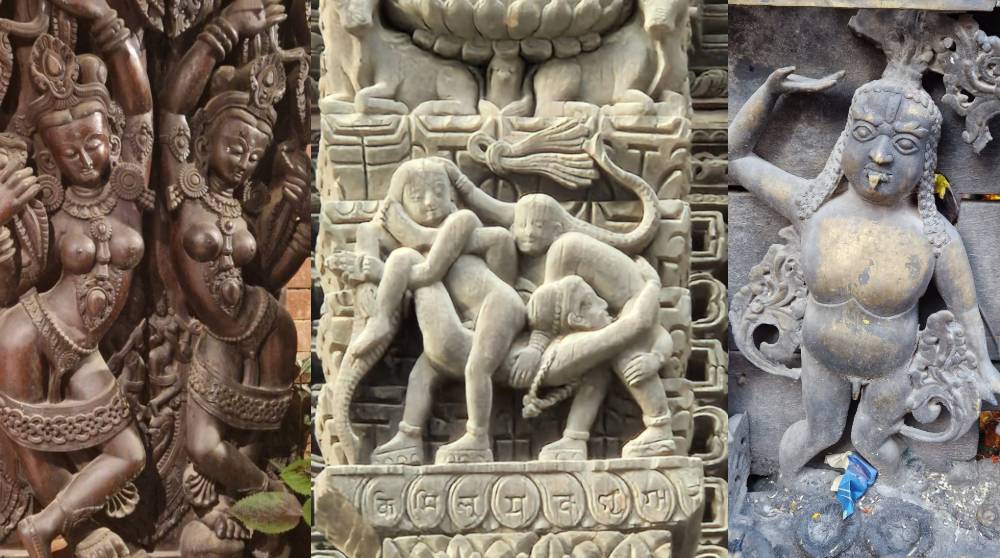
This is not self-realization. It is assimilation—a desperate mimicry of the very system that suffocates us. We have replaced our ancient and fluid understanding of Tritiya Prakriti—the “third nature” that existed outside rigid binaries—with a colonial model of gender that demands conformity. In doing so, we have traded authenticity for acceptability.
4. The Flesh Market and Gendered Demand
Nowhere is this assimilation more brutal than in the flesh market of queer survival—where desirability and livelihood are dictated by patriarchy itself.
Feminine-presenting trans women or third-gender individuals are fetishized—their bodies consumed as exotic, forbidden, and submissive. Their desirability feeds on the same patriarchal gaze that objectifies all women. Conversely, trans men and masculine-presenting individuals remain largely invisible—erased by a system that grants no sexual agency or purchasing power to women, their potential clients.
Thus, even our survival economy is chained to patriarchy’s script: demand flows only where masculine-male desire dictates. This economic precarity is not accidental. It is structurally produced by gendered capitalism—where even the illusion of liberation is sold through the body, priced by patriarchy, and purchased through shame.
5. The Call for Intersectional Integrity
Nepal’s GSM/LGBTIQ+ movement now stands at a moral crossroads. We can continue to bask in the comfort of partial freedom—one that rewards the caste-privileged, binary-conforming, cis-passing few—or we can confront the uncomfortable truth that queer liberation cannot exist without dismantling all systems of oppression.
Casteism, patriarchy, class privilege, and rigid gender binaries are not side issues—they are the very walls of our confinement. A depatriarchalized movement must reject them in thought, desire, and practice.
Liberation will not come from mimicry but from reclamation—of our indigenous gender plurality, our cultural self-worth, and our intersectional integrity.
6. The real work begins within—
When a gay man rejects caste privilege as an aphrodisiac.
When a trans man defines his masculinity on his own terms.
When a community refuses to reproduce the hierarchies it once fought against.
Only then will our movement stop being an echo of oppression and start becoming a chorus of liberation—rooted, radical, and whole.


Copyright © All right reserved to pahichan.com Site By: Sobij.
