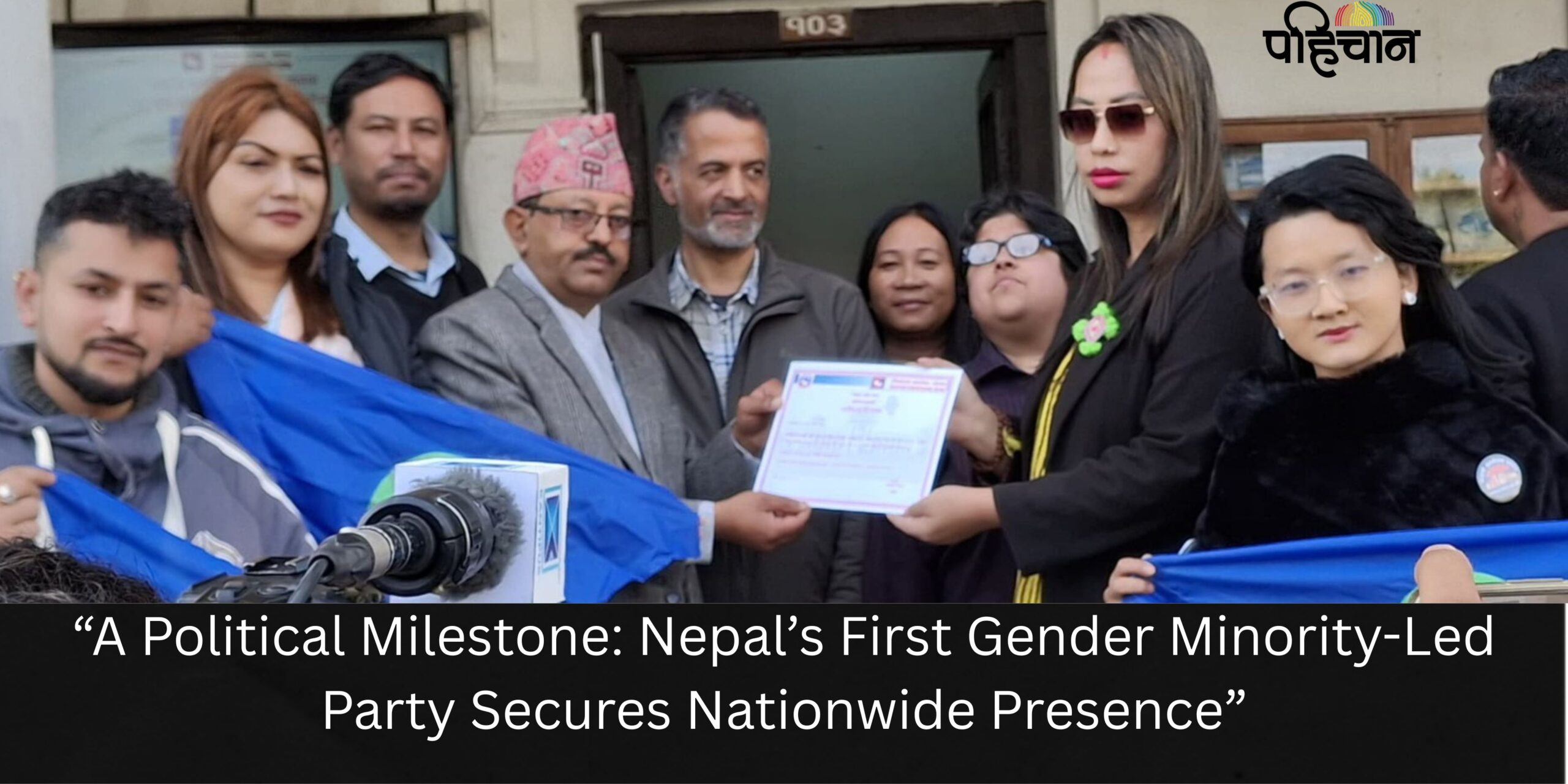
Kathmandu – For the first time in Nepal’s electoral history, the Inclusive Socialist Party—established under the leadership of gender and sexual minorities, including the third-gender community—has successfully expanded its network nationwide.
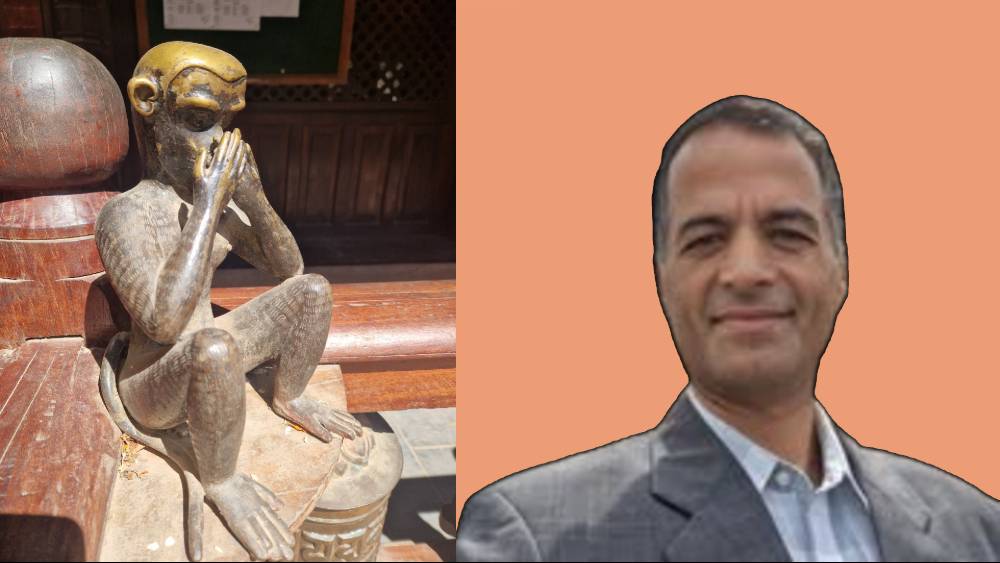
The party, with former Constituent Assembly member Sunil Babu Pant as its patron and advisor, has received votes from most constituencies across the country, except for a few.
Amid a long struggle for identity rights and political representation, as having participated in elections through its own party immediately after its establishment for the first time in the history of Nepal has been challenging. However, despite limited resources, social barriers, and structural difficulties, the party led by Numa Limbu (Chanchala) as the founder president has managed to establish its presence.
In the House of Representatives election held on Falgun 21 following the Gen-Z movement, the Inclusive Socialist Party could not field candidates in 159 constituencies under the direct (first-past-the-post) system. It fielded direct candidates in only six constituencies, highlighting how difficult electoral competition is for new and marginalized groups.
Although the party was registered with the Election Commission only after the election date was announced, it managed to secure 1,397 votes under the proportional representation system despite limited time, resources, and structural access.
Based on these votes, the party appears to have successfully expanded its network nationwide, which is seen as an important sign toward building political presence for gender and sexual minority communities.
In Koshi Province, the party received a total of 47 votes across districts such as Taplejung, Panchthar, Ilam, and Jhapa.
Similarly, it received 86 votes from Sankhuwasabha, Tehrathum, Bhojpur, Dhankuta, and Morang. In Morang-4, party अध्यक्ष (president) Numa Limbu (Chanchala) herself contested as a direct candidate, signaling leadership involvement on the ground.
Under proportional representation, the party received 56 votes from Sunsari and additional votes from Solukhumbu, Khotang, Okhaldhunga, and Udayapur. In Okhaldhunga, Pinky Rai was fielded as a direct candidate representing identity-based politics.
The party marked its presence in all districts of Koshi Province for the first time. Receiving votes from all constituencies is considered a significant achievement not only for the party but also for the broader struggle of political participation by gender and sexual minorities.
In Madhesh Province, the party received 37 votes from Saptari and 27 votes from Siraha under proportional representation. It also received votes across Dhanusha, Mahottari, Sarlahi, Rautahat, Bara, and Parsa districts, though in some constituencies it received zero votes, reflecting the challenges of building a support base.
In Bagmati Province, the party secured votes from districts including Dolakha, Ramechhap, Sindhuli, Rasuwa, Dhading, Nuwakot, and Kathmandu Valley. It also fielded direct candidates such as Surendra Pandey in Kathmandu-1 and Purnachandra Paudel in Kathmandu-10.
Additional votes were received from Bhaktapur, Lalitpur, Kavrepalanchok, Sindhupalchok, Makwanpur, and Chitwan. In Kavre-1, Binod Lama (Konika) contested as a direct candidate.
Across the country, the party has gained votes in scattered regions, laying a foundation for organizational expansion. Participation in elections and gaining votes through its own party represents a challenging yet important milestone in Nepal’s political history for gender and sexual minority communities.
In Gandaki Province, despite limited resources and social barriers, the party established its presence with votes from Gorkha, Lamjung, Kaski, Tanahun, Syangja, Nawalparasi (East), Mustang, Myagdi, Baglung, and Parbat.
In Lumbini Province, the party continued efforts to maintain its organizational presence, receiving votes from Gulmi, Palpa, Arghakhanchi, Rupandehi, Kapilvastu, Rukum (East), Rolpa, Pyuthan, Dang, Banke, Bardiya, and Nawalparasi (West). In Rupandehi-2, Devendra Bahadur Khatri (Madhu) was fielded as a direct candidate.
In Karnali Province, despite even more challenging geography and social conditions, the party maintained its presence with votes from Salyan, Jumla, Kalikot, Humla, Jajarkot, Dailekh, Surkhet, and Rukum (West), though it received zero votes in Dolpa and Mugu.
In Sudurpashchim Province, the party continued its presence, receiving votes from Bajura, Achham, Bajhang, Doti, Kailali, Darchula, Baitadi, Dadeldhura, and Kanchanpur.
From constituencies where it received zero votes to those where it gained support, this journey stands as a clear reflection of the struggle, patience, and persistence of gender and sexual minority communities in carving out a place in national politics through their own political party.


Copyright © All right reserved to pahichan.com Site By: Sobij.
