
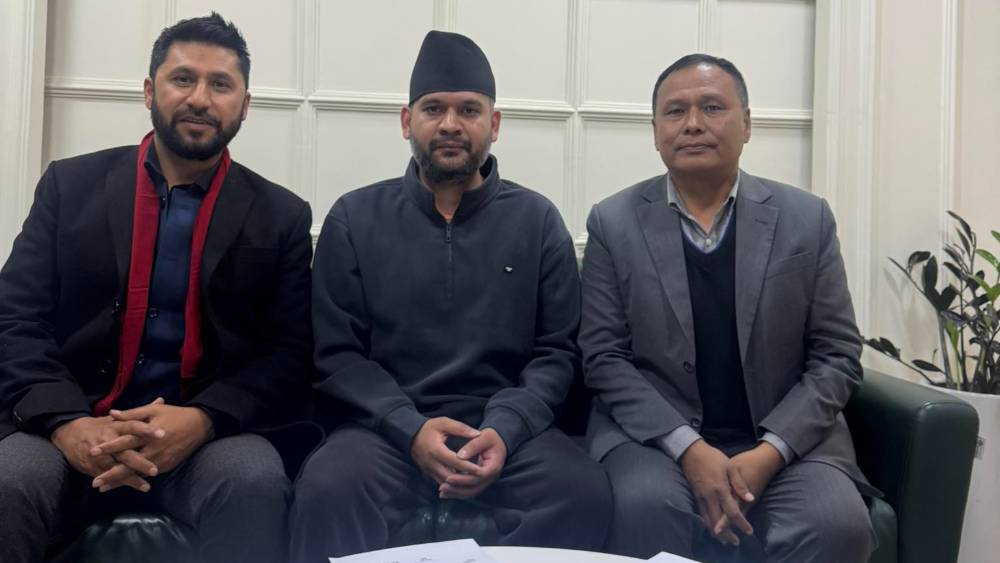
The much-discussed convergence of Balen Shah, Rabi Lamichhane, and Kulman Ghising is being celebrated as a bold new front—an antidote to Nepal’s exhausted political old guard of the Nepali Congress, UML, and Maoists. Read merely as a political game, the alignment is indeed intriguing. But viewed through a gendered lens, it reveals something deeply unsettling: not transformation, but the consolidation of patriarchy in a new, more muscular form.
This is not a politics of change. It is men against men—and only men.
The visual itself tells the story. Three men. Decisive, assertive, confrontational. The unspoken message is familiar and dangerous: only men can lead, only men can decide, only men can rescue the nation from decay. Women, non-binary people, and gender minorities are once again rendered invisible—spectators in a drama about power that refuses to imagine leadership beyond masculinity.
Nepal has seen this movie before. The old parties were also built on strongmen culture, patronage networks, and hyper-masculine authority. What makes this new front troubling is not merely that it excludes women and other genders—but that it reinforces the idea that exclusion is natural, efficient, even necessary in moments of “national crisis.”
When politics becomes a stage for male saviors, ruthlessness is never far behind. Macho politics thrives on urgency, confrontation, and domination. It glorifies decisiveness over deliberation, authority over accountability, strength over care. History—Nepal’s and the world’s—shows us that such politics rarely democratize power. They centralize it.
The defenders of this unity argue that gender can be addressed later—that first the “system” must be fixed. This argument is neither new nor innocent. Patriarchy has always postponed equality in the name of efficiency. “Not now,” it says. “After the revolution.” “After stability.” “After we win.” Women and marginalized genders are told to wait—again.
But the truth is uncomfortable: movements that do not challenge patriarchy at their inception rarely do so once they gain power.
The deeper question, then, is not only why men refuse to see women and other genders as leaders—but why so many women in Nepal have been structurally conditioned to wait for male endorsement before stepping forward. This is not a failure of ambition. It is the product of political parties, media ecosystems, donor cultures, and social norms that reward women for loyalty, silence, and support roles rather than leadership.
Women are invited to clap, not to command. To legitimize, not to lead.
And when women do assert authority independently, they are labeled divisive, emotional, or “not serious enough” for hard politics—the same hard politics that men monopolize and then claim is gender-neutral.
What is being sold as a “new politics” today is, in fact, an old script with new actors. It challenges aging elites, yes—but it leaves untouched the most enduring hierarchy of all: male dominance in public power.
If Nepal truly seeks transformation, it must abandon the fantasy that men—however competent, honest, or charismatic—will rescue the nation alone. Democracy is not renewed by replacing old men with new men. It is renewed by redistributing power itself.
Until women and gender-diverse people are not merely present but central to political leadership—without waiting for male permission—Nepal’s so-called alternatives will remain exactly what they are: a reshuffling of patriarchy, not its undoing.
This is not change.
This is men fighting men—while the rest are told, once again, to wait.
Copyright © All right reserved to pahichan.com Site By: Sobij.
