
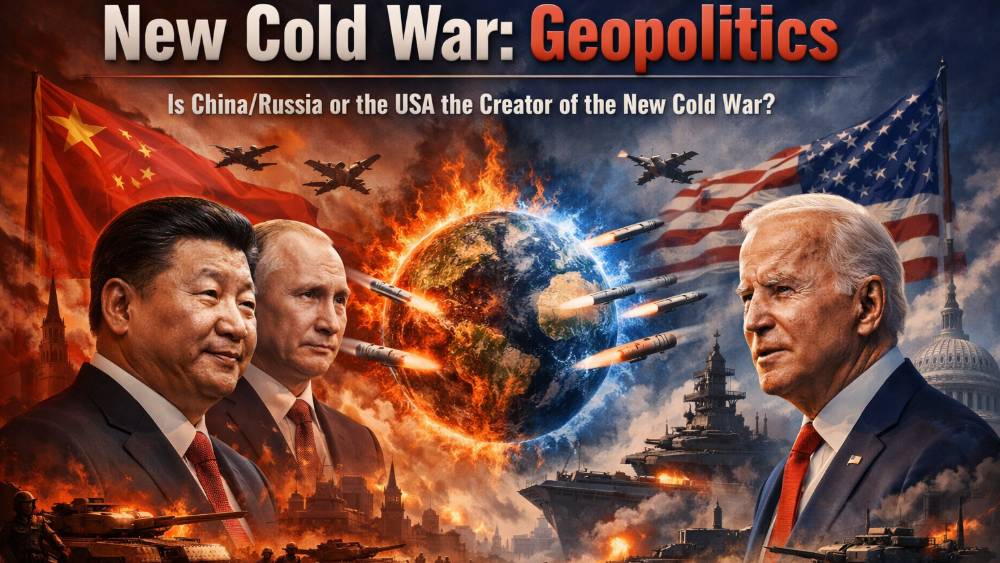
The idea of a “New Cold War” has become a prominent concept in contemporary geopolitics, referring to the growing rivalry among major global powers, particularly the United States, China, and Russia. Unlike the Cold War of the twentieth century, which was largely defined by ideological confrontation and military standoffs between two blocs, the New Cold War is more complex and multidimensional. It is driven by competition in geopolitics, economic influence, technology, energy security, and global governance. Instead of direct military confrontation, this rivalry is expressed through economic sanctions, trade wars, strategic alliances, proxy conflicts, and competition for influence in key regions of the world.
The term “New Cold War” has increasingly entered global political discourse to describe the growing strategic rivalry between major world powers—primarily the United States on one side and China and Russia on the other. Unlike the Cold War of the 20th century, which was largely ideological and military between the US and the Soviet Union, the New Cold War is multi-dimensional, encompassing geopolitics, economics, technology, energy security, and regional influence.
The New Cold War does not rely on direct military confrontation but rather on proxy conflicts, economic sanctions, trade wars, technological competition, and strategic alliances. It is shaped by:
• US-led liberal democratic systems: US-led liberal democratic systems, stemming from Enlightenment ideals of individual rights and self-governance, emphasize free markets, rule of law, human rights, and representative democracy, forming a global order promoted post-WWII through institutions like the UN, but now face challenges from rising authoritarianism (China, Russia) and internal populist movements, leading to a fracturing world order and questions about the system’s future.
• China’s state-led economic and political model : China’s state-led model, termed a “socialist market economy,” blends authoritarian CCP rule with significant market activity, featuring strong state control in strategic sectors (banking, energy) via massive SOEs, alongside dynamic private enterprise and extensive state-directed industrial policy (Five-Year Plans, tech self-sufficiency) for national development, creating a unique hybrid of state capitalism and market forces.
• Russia’s challenge to Western security dominance: Russia’s challenge to Western security dominance is multifaceted, encompassing conventional military power, nuclear threats, hybrid warfare, and diplomatic efforts to create a multipolar world order that curtails Western, especially U.S., influence. Russia views the current U.S.-centric system as a threat to its sovereignty and seeks to re-establish itself as a global power.
First, the New Cold War is a one-sided one. While the U.S. treats the CCP as an ideological enemy, China does not reciprocate. The Chinese government holds a critical view about the American government and many of its political practices, but it refrains from denouncing American values. Part of the reason is that most Chinese people embrace those values. Second, apart from its Belt and Road Initiative (BRI), China is on the defensive toward America’s China policies.
For example, China has not retaliated against U.S. technological bans even if it does have some tools to do so. Third, unlike the Soviet Union and the U.S. in the old Cold War, China and the U.S. are now deeply connected by trade, investment, and people-to-people exchanges. This greatly increases the complexity of the New Cold War.
The Trump administration wanted to simplify the bilateral relationship by decoupling with China on all fronts. But that approach entails tremendous costs on both sides. For this reason, decoupling has progressed slowly. American policy makers have no choice but to navigate through the complexity of U.S.–China economic relations.
Fourth, geopolitical rivalry has not evolved into head-on military confrontation between the two countries, nor has it led to any proxy war. But there is no guarantee that military conflicts will never happen between the two countries. The South China Sea, the East China Sea, and the Taiwan Strait are all potential flashpoints.
A central debate surrounding the New Cold War is the question of responsibility: whether it is primarily created by the United States or by China and Russia.
From the American perspective: China and Russia are viewed as challengers to the existing international order. The United States argues that China’s rapid economic rise is supported by state-controlled practices that distort global markets, while Russia is accused of undermining international norms through military interventions and territorial aggression. In response, the US has pursued policies such as strengthening NATO, imposing sanctions, forming new security alliances, and restricting access to advanced technologies, presenting these actions as necessary measures to protect global stability and democratic values.
The administration of Donald Trump made a decisive turn in America’s China policy. Its China policy can be best described as the approach of a New Cold War. Like the American–Soviet Cold War, the New Cold War encompasses ideology, geopolitics, and economic relations. On the ideological front, the Trump administration, represented by Secretary of State Mike Pompeo, waged a campaign to demonize the Chinese Communist Party (CCP) and its ideology. Unlike the U.S. administrations of the past 50 years, which believed that China could be won over to the American side, the Trump administration viewed China as an ideological enemy that posed an imminent threat to the American way of life.
From the US viewpoint, China and Russia are revisionist powers attempting to challenge the existing international order. The US argues as China uses unfair trade practices, state subsidies, and intellectual property theft and Russia undermines sovereignty through military interventions (Ukraine, Georgia)
From the China/Russia perspective: In contrast, China and Russia argue that the United States is the main driver of the New Cold War. From their viewpoint, Washington seeks to maintain global dominance by expanding military alliances, using economic sanctions as political weapons, and attempting to contain the rise of alternative power centers. NATO’s expansion toward Russia’s borders and US-led efforts to limit China’s technological and economic growth are seen by Beijing and Moscow as direct threats to their national security and sovereignty. As a result, both countries portray their actions as defensive responses rather than aggressive initiatives.
In conclusion, the New Cold War is a complex and evolving phenomenon shaped by global power transitions rather than the actions of a single country. Its economic impact is widespread, influencing energy markets, trade patterns, and political strategies across the Middle East, Asia, and Europe. While the rivalry has created new opportunities for some nations, it has also introduced uncertainty and instability into the global economy. In this emerging world order, middle and regional powers increasingly seek flexible and independent approaches to avoid being trapped in rigid geopolitical blocs.

Copyright © All right reserved to pahichan.com Site By: Sobij.
