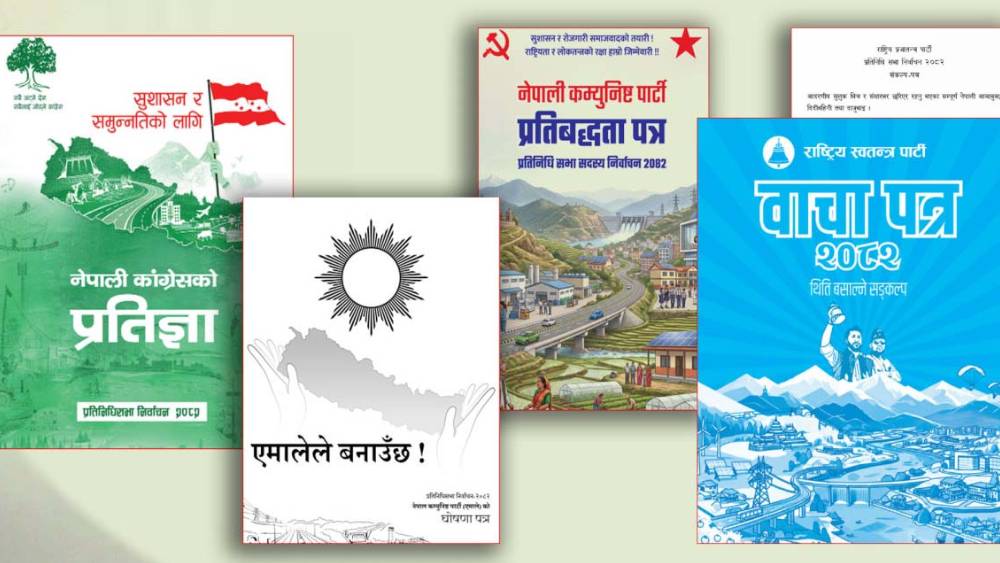
The House of Representatives election of Nepal 2026 stands at a historic turning point. Gender and sexual minority communities have begun intervening in political competition with their own voices and candidacies. In Nepal’s recent electoral landscape, slogans of inclusion, equality, and social justice are widely heard. But the question is—how much have these words been translated into practice?
Mayako Pahichan Nepal has conducted a detailed review of the manifestos of more than 40 political parties registered so far with the Election Commission. The findings of this review show that while many parties have mentioned gender and sexual minority communities by name, there are serious shortcomings in candidacy, policy clarity, and implementation plans.
Although many party manifestos use general language of equality, their positions differ significantly when tested against actual candidacies and policy specificity.
1. CPN-UML (Communist Party of Nepal – UML)
Exact sentence mentioned in the manifesto:
“We declare that we will protect senior citizens, persons with disabilities, the helpless, the orphaned, those left behind, the neglected, the oppressed, Dalits and other marginalized communities, sexual and gender minorities, and marginalized individuals, ensuring them a dignified life and practicing democracy based on human values and welfare.”
Key points: Social security allowance, employment priority, health facilities, women-centered programs (free health services, maternity allowance, free sanitary pads).
Analysis: UML has included the community from the perspective of protection and human values. Although both sexual and gender minorities are clearly mentioned in the manifesto, it has not presented any direct or proportional candidates, revealing a significant gap between policy and practice.
2. Nepali Congress
Exact sentence mentioned in the manifesto:
“The constitutional rights of gender and sexual minority communities will be implemented, and their identity will be respected in citizenship and other official documents. A discrimination-free environment will be guaranteed in schools and hospitals.”
Key points: Discrimination-free education and health services, equal opportunity, ensuring dignity and access for all.
Analysis: The Congress has clearly included both terms—gender and sexual. However, there are no actual candidates, showing a clear gap between linguistic commitment and practical action.
3. Rastriya Swatantra Party (RSP)
Exact sentence mentioned in the manifesto:
“Businesses with at least 60 percent shares or participation of women or sexual minorities will be provided special concessions and operational grants.”
Key points: Priority for economic empowerment and entrepreneurship, special support for women and sexual minority entrepreneurs.
Analysis: RSP has mentioned only “sexual minorities”; there is no clear mention of gender minorities (gender identity). This makes it clear that RSP’s policy supports sexual minorities, but does not present a clear policy regarding gender identity.
Similarly, although 1 direct and 1 proportional candidate have been fielded, there appears to be weakness in the language guaranteeing legal/constitutional rights.
4. Samaabeshi Samaajwadi Party
Exact sentence mentioned in the manifesto:
“To build an inclusive society, special reservations and skill-based training will be arranged for sexual and gender minorities to make them economically empowered.”
Key points: Reservation, training, economic empowerment.
Analysis: This party appears the most progressive. By fielding 6 direct candidates and 13 proportional candidates—among a total of 15 PR candidates with significant GSM participation—it has established a new standard in Nepal’s politics.
This is not merely decorative language in a manifesto—it is a direct example of real power-sharing and participation of the community in the political sphere.
5. Gatishil Party
Exact sentence mentioned in the manifesto:
“Every citizen shall have full rights to live based on their sexuality and gender identity. Disrespectful behavior carried out by calling someone ‘third gender’ will be made punishable.”
Key points: Respect for identity, punishable legal protection.
Analysis: While the manifesto speaks of respect for identity, presenting the term “third gender” itself as disrespectful may create misunderstanding from a linguistic and identity perspective.
This indicates that further groundwork is needed to understand the community’s sensitivities. 1 propertionate candidate is standing from the GSM community.
6. Pragatishil Lokatantrik Party
Exact sentence mentioned in the manifesto:
“Sexual minorities will also be provided equal rights as other citizens and proportional access to state opportunities.”
Key points: Equal opportunity and proportional access.
Analysis: It appears to include only “sexual minorities”; the clear terminology of “gender minorities” is missing. Although the language is general, policy depth is weak. 1 propertionate candidate is standing from the GSM community.
7. Janata Samajwadi Party (JSP)
Exact sentence mentioned in the manifesto:
“For identity and rights, the rights and interests of sexual and gender minorities will be fully implemented in accordance with the spirit of the Constitution.”
Key points: Implementation of constitutional rights, protection of rights.
Analysis: Despite clarity in language, the number of direct/proportional candidates is zero. This shows the gap between the slogan of inclusion and actual practice.
8. Ujyaalo Nepal Party
Exact sentence mentioned in the manifesto:
“Ending all forms of gender discrimination existing in society, sexual minorities will be brought into the social mainstream.”
Key points: Social inclusion, ending discrimination, equality in society.
Analysis: Although the policy language is positive, the term “gender minorities” is not clearly stated, and representation at the direct/proportional candidate level is missing.
Conclusion
1. Center of representation: The Samaabeshi Samaajwadi Party has fielded significant candidates in both direct and proportional categories, setting a positive example of bringing the community into leadership and decision-making processes.
2. Manifesto versus practice: Major parties such as UML and Congress, despite using appealing language, appear to view the community merely as a “vote bank” by not fielding candidates.
3. Only ‘sexual minorities’: Rastriya Swatantra Party, Pragatishil Lokatantrik Party, and Ujyaalo Nepal Party have used only the term “sexual minorities,” which does not clearly encompass the gender identity aspect.
4. Linguistic/identity controversy: The statement by Gatishil Party regarding “third gender” shows the possibility of misunderstanding in matters of identity and respect.
5. Ambiguity among other parties: Many parties have not even clearly mentioned gender and sexual minority communities.
In Nepal’s democracy, rights are not ensured merely by words written in manifestos.
For that, direct presence in Parliament, leadership, and real participation in policy-making processes are necessary. This election is not only a test of collective inclusion, but also a test of advancing identity and rights.
Copyright © All right reserved to pahichan.com Site By: Sobij.
