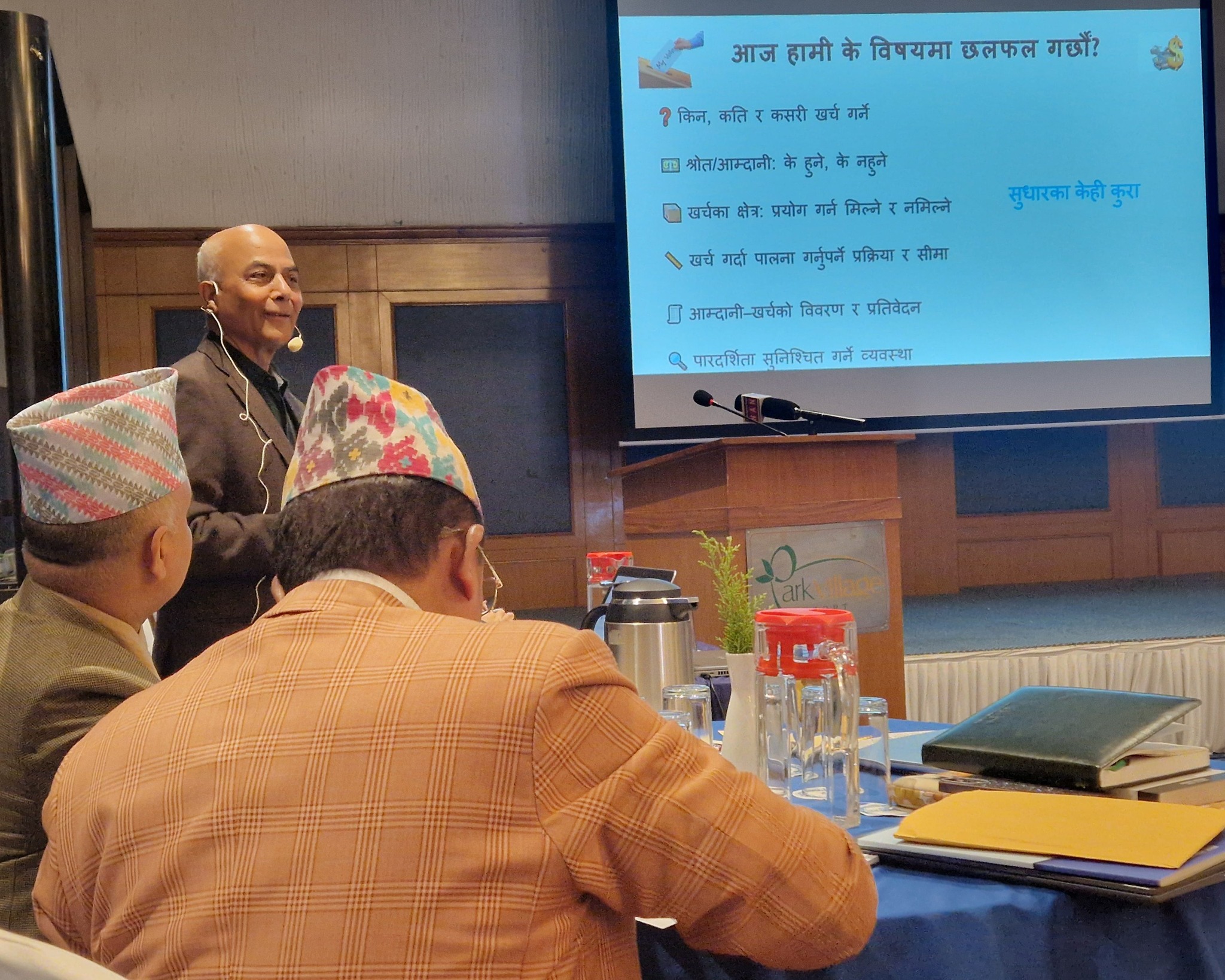
Today, I attended a program organized by the Election Commission of Nepal. A former Election Commissioner, Bhojraj Pokharel, presented data that was both revealing and disturbing. The figures on election spending, sources of campaign finance, and patterns of representation raise a fundamental question: What is the purpose of elections if their outcomes repeatedly produce instability, corruption, and exclusion?
Elections are meant to embody the will of the people. In theory, representative democracy allows citizens to choose leaders who reflect their aspirations and safeguard their rights. But when election spending rises exponentially, when those who spend more consistently win, and when marginalized communities struggle even to enter the race, we must pause and reassess whether the system is working as intended.
The Escalating Cost of Elections
Data from Nepal’s Election Commission show that election spending has increased dramatically in recent cycles. Despite legally defined spending ceilings, real expenditures often far exceed the prescribed limits. Campaigns demand massive investments in publicity, mobilization, media outreach, transportation, and organizational machinery.
The practical outcome is predictable: candidates with access to wealth—or to wealthy backers—gain structural advantages. Elections become less about ideas and more about financial capacity.
For marginalized communities, women, and Gender and Sexual Minority (GSM) candidates, fundraising is not merely difficult—it is structurally unequal. Wealth accumulation in Nepal remains deeply gendered and caste-based. Expecting equal competition in such unequal conditions is unrealistic.
If democracy is reduced to a marketplace where influence is purchased, then elections risk becoming legitimized auctions of power.
Representation Without Proportionality
Representative democracy claims to mirror society. Yet where are women representatives in proportion to their population? Women make up roughly half the population, but their presence in directly elected positions remains disproportionately low. The same is true—more starkly—for GSM communities.
Yes, Nepal’s constitution mandates inclusion and proportional representation in certain electoral lists. But in practice, direct elections remain dominated by men, particularly those from dominant castes and established political families.
If the system consistently produces male-dominated legislatures, can we honestly claim it reflects society? Or does it reproduce a patriarchal power structure under the label of democracy?
Representative democracy, as currently practiced, often operates within patriarchal norms—money, muscle, networks, and lineage matter more than lived experience, grassroots credibility, or marginalized identities.
Corruption and Instability: Structural Outcomes
High campaign spending does not disappear after election day. It must be recovered. When candidates invest enormous sums to win, the temptation—or pressure—to recoup that investment through public contracts, patronage, or policy favors becomes systemic.
Thus, corruption is not simply a moral failure of individuals; it is often embedded in the financial architecture of elections.
Furthermore, when political competition becomes transactional, coalition instability follows. Governments form not purely on policy alignment but on negotiated power-sharing and resource distribution. The result is frequent changes in government, weakened policy continuity, and public distrust.
If elections repeatedly produce unstable governments and corruption scandals, we must ask whether the problem lies not only in leadership but in the structure itself.
The Exclusion of the Marginalized
For many women, Dalits, Indigenous communities, persons with disabilities, and GSM individuals, running for office is financially prohibitive. Campaigns require resources far beyond personal savings.
Political parties often prioritize candidates who can “self-finance” their campaigns.
This reinforces a vicious cycle:
Those with money win.
Those who win gain access to power and further economic opportunity.
Those without resources remain excluded.
In such a system, democracy becomes formally inclusive but substantively exclusive.
Is It Worth Organizing Such Costly Elections?
Elections consume enormous public resources: administrative logistics, security deployment, voter education, monitoring, and post-election dispute management. On top of that are the private campaign expenditures by candidates and parties.
If the outcomes frequently include:
Corrupt leadership,
Political instability,
Underrepresentation of women and GSM communities,
And policy capture by economic elites,
Then it is legitimate to ask: Are we investing billions in a system that reproduces the very problems we seek to solve?
Could those resources be redirected—at least partially—toward education, public health, environmental protection, and green job creation?
Beyond Competitive Electoralism: Toward Participatory Democracy
This is not an argument to abolish elections entirely. Rather, it is an invitation to rethink democracy beyond periodic voting.
Participatory democracy offers complementary models:
Citizens’ assemblies selected by sortition,
Participatory budgeting at local levels,
Community councils with binding decision-making authority,
Digital deliberative platforms,
Stronger local autonomy with inclusive representation mandates.
Such mechanisms can reduce the dominance of money, amplify ordinary voices, and foster direct civic engagement.
In participatory models, influence is not determined by campaign budgets but by deliberation, collective reasoning, and shared responsibility.
Reimagining Representation
If representative democracy systematically underrepresents women and GSM communities, structural reforms must go deeper than quotas. We may need:
Publicly funded campaigns to reduce dependency on private money.
Strict enforcement of spending limits.
Transparent, real-time disclosure of campaign finance.
Gender-equal and diversity-based candidate nomination requirements.
Rotational leadership models.
Community-based accountability mechanisms.
Democracy should not merely be about choosing rulers; it should be about distributing power.
A Necessary Conversation
The purpose of elections is to translate public will into governance. But when elections become prohibitively expensive, structurally unequal, and corruption-inducing, they risk losing moral legitimacy.
Democracy is not sacred because it is electoral. It is sacred because it promises dignity, equality, and participation.
If elections fail to deliver these values, then democratic societies have a responsibility to innovate—to move beyond rigid models and experiment with more inclusive, participatory systems.
The real question is not whether we should have elections.
The real question is: What kind of democracy truly serves the people?
Until we confront that honestly, instability, corruption, and exclusion will remain recurring outcomes—no matter how many ballots we cast.

Copyright © All right reserved to pahichan.com Site By: Sobij.
