
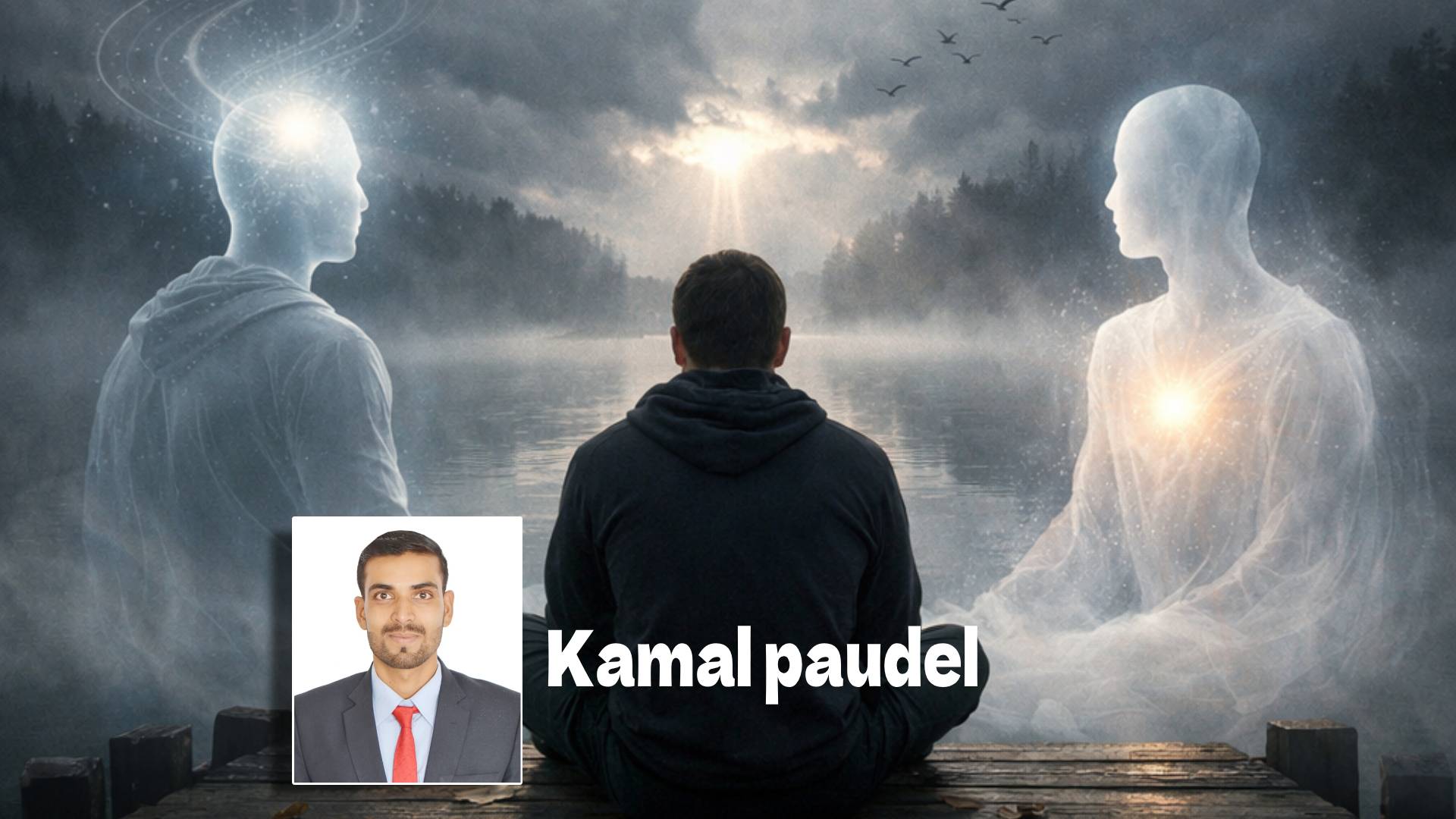
Greetings, dear reader, and welcome to this short campfire of my thoughts. Please take a seat for a while; this is not a lecture, but the echoes of cryptic souls like all of ours. If I could make you feel and think even a bit differently by the end of this short piece, I would be more than happy. Once again, welcome, curious soul. Let’s explore it barefoot, feeling the texture of every word.
“Hey, who are you?” came the question. “Are you asking me?” was the reply. “Yes, I am talking to you.” “I am nobody.” “Are you kidding me? I am genuinely asking you.” “Well, relax, my name is Nobody.” “Oh, really?” “Any doubt!” “Yes, I mean, I never heard such a name before.” “So, my name needs your hearing for its validity, or do you think my name is invalid?” “No, no, I didn’t mean that.” “Instead, I am Invalid. I mean, my name is invalid. I was named this by Everybody.” “You are a sophist.” “Maybe yes, maybe no.” “Who is Everybody now?” “Invalid’s dad.” “That means your father.” “Right.” “Can’t you say it straightforwardly?” “Does anything happen straightforwardly in life?” “Okay, fine. But why do you need twists and turns in every question?” “Because life is not a question.” “Please, stop it.” “But why, are you not enjoying?” “Yes, because I am more than satiated now.” You see, people seldom want to talk about life. The interrogation remained unanswered……!
Hello, dear pursuer, are you still there, or have you already left? Once again, thank you for being with me until now. Let’s continue further. How often do random thoughts come into your mind? I think everyone has a thinking nature. One of the criteria for measuring overthinking may depend on how much, how often, and to what extent someone thinks. For instance, the above piece resembles how someone does a monologue. However, there is a Caution for us. When someone overthinks, that can be one of the foremost sources for cultivating depression in them, too. While advocating for this logic, another thoughtful query, on the other hand, remains unanswered. That is, if we don’t even ponder, are we human beings? At the same time, we need to deal with numerous aspects of our life regularly, each passing moment, day, week, month, etc. If you hold this belief as one of the unavoidable harsh truths of our everyday life, then another logic emerges again. We can agree that we certainly require some amount of thinking to solve our possible problems and smooth out our lives. Thus, another query asks us again, to what extent should someone think? This is the very query that has frequently stolen even my mental peace at times. That is why the present write-up holds the topic “When Silence Becomes Loud: An Unspoken Conversation Between Mind and Soul.” You and I, whether we have met so far, might have thought the same unspoken questions. I believe silence can sometimes speak louder than the loudest. When we arrive at such points where we must decide what to do now, don’t you think, “I must think and decide.” In this way, there is a long list of such questions, and I keep trying for their appropriate answers. What do you think about silence? Is silence really silent? Or is silence ringing louder than the noise? What this silence actually is! I believe that you have now arrived at the crossroads where reasons must meet your answers for such queries.
Dear reader, let’s explore my personal thoughts together. I find my classes buzzing with a newly emerged, though familiar silence in these days’ classrooms. There is no attentive silence for genuine inquiry. I only find the gloomy, bulky, and buried stillness of our students’ minds everywhere. Before the arrival of social media and AI, at least, the eyes of the past students would reflect a window to curiosity in them. But that inquisitive gateway has now been replaced with glowing screens as a synchronized tap of thumbs and scrolling feeds. As I stand in today’s world, a lecturer in a world of digital noise, I am confronted with a new, profound question that mirrors the timeless quest for self: “Who are they?” I mean my students. Really, who are they?
These students, my students, are not merely inattentive. Rather, they are engaged in a different kind of conversation, one that is not happening in my students’ physical presence, too. The silence I perceive is not really silent; it is a crowded space filled with the noise of social media notifications, the passing endorsement of likes, and the digital whispers of AI, which promises to answer every question even before it is asked. My role, I realize, has completely shifted now. I am no longer only a source of knowledge, but a competitor for an insufficient resource: attention. In this era of AI, the query of identity is no longer only about one’s name or place in society, but also about one’s digital footprint and the personality curated for an online audience. Nowadays, my students’ self is no longer a singular or fluid entity. It is a fragmented collection of profiles, stories, and filters. I find that my students’ internal conversations about the mind and soul have now become an expressed performance. For them, the endless reel of highlights means a lot to define their life or any life in minutes. This continued superficial projection has left little room for my student’s inner journey of self-reflection.
I wonder if this constant validation-seeking is a symptom of a deeper, unspoken anxiety. In this age of AI, the teachers’ essence, their struggles, efforts, and unique perspectives have increasingly been challenged. I also feel my role has been devalued in this race. Perhaps the silence in my classroom is a self-justifying or self-protective mechanism as a departure from an AI-occupied world that seems to require less of our authentic selves increasingly. My students are not poor in studies because they lack intelligence, but because the studious nature of students has felt like a losing battle against a system that can produce a “better” result instantly. Though human beings developed this system, they have deceived themselves about their own advancement. The silence, therefore, is not invalid. It is a loud, unspoken conversation between our minds, which are saturated with digital stimulus, and our souls, which crave authentic connection and purpose.
In the classrooms, my challenge is not to compete with the digital world, but to help my students find a way to quiet the external noise long enough to hear their own internal voice. As a teacher, I strongly believe that I must find a way to reintroduce the dignity of struggle, the value of effort, and the unique, irreplaceable quality of a human-created thought to my pupils. The question “Who am I?” has become “What is the value of me in a world that can replicate me?” and until we address that unspoken question, the silence in the classroom will remain loud and deafening. I think silence is often mistaken for absence, yet in its quietness, it grows into a sound no ear can catch but every bone can feel. From my perspective, silence is not empty. Rather, it is the raw, uncut voice of the soul. Silence echoes every one of our feelings and thoughts in the language we speak, and our mind struggles to translate them judiciously.
While people may fear the pause between words, I see it as the theater where truth performs without an audience. Our mind, which is perhaps restless and logical, brings lists, questions, and unfinished arguments. On the other hand, our soul, which is patient and infinite, responds with sighs that are not sighs, with shadows that are not dark. Again, from here emerges another different critical perspective. Should silence not be seen merely as a symptom of disengagement? Well, I think it can be an active, thinking, and even disobedient force for a space of reflection, disruption, and potential. I believe that silence is not an enemy. Instead, it is an invitation to listen, to learn. As teachers, when we give voice to the unspoken questions in class and without leaving our students buried in the screens, we then open a space for their souls to speak. Thus, allowing silence to be expressed in words means giving our students a chance to reveal their inner worlds.
When silence grows loud, it does not mark the end, yet it still marks a beginning. That is why the silence in the classroom should ask us: How can we rebuild the teacher–student relationship? How can we make the classroom a space for sustained attention and deeper thought? When we truly listen, the silence that once felt heavy becomes the seed of transformation, or also a courage to pause before speaking. Therefore, silence, for me, is a bridge of an invisible architecture connecting the two most distant lands within me: the restless mind and the eternal soul. It is the place where I stop being just a thinker and start becoming a witness. Dear curious soul, thank you for your time and engagement thus far. See you next time.
Assistant Professor,Chautara Multiple campus






Copyright © All right reserved to pahichan.com Site By: Sobij.
