The Universal Declaration of Human Rights begins with a powerful promise: “All human beings are born free and equal in dignity and rights.”
It is a beautiful sentence.
It is also, for billions, a daily lie.
Because if all humans are truly equal, why do some groups need their rights to be spelled out, fought for, and constantly defended—while others simply live them without question?
Why do we have to write laws for women, for Dalits, for Black people, for gender and sexual minorities, for persons with disabilities—yet no one ever drafts a “Men’s Rights to Dignity Act” for upper-caste, upper-class, able-bodied men?
Because the truth is uncomfortable:
Law does not create equality. Law responds to inequality.
1. The Invisible Default Human
In practice, the “universal human” imagined by law has never been universal.
It has a body, a caste, a gender, a class.
It is male.
It is privileged.
It is often upper caste, upper class, and socially dominant.
This person does not need special legal protection because the system already reflects his reality. His identity is not “protected”—it is normalized.
He does not need inclusion policies because he was never excluded.
He does not need affirmative action because he has always had access.
He does not need recognition because he was never invisible.
He is the law’s starting point. Everyone else is an amendment.
2. Why Marginalized Groups Need Law
When women demand laws against violence,
when Dalits demand anti-discrimination protections,
when GSM/LGBTQI+ people demand recognition,
when persons with disabilities demand accessibility—
they are not asking for “extra rights.”
They are asking for entry into humanity as defined by law.
These laws exist not because these groups are “special,”
but because they were historically excluded from the so-called universal.
So the real question is not:
“Why do marginalized groups need laws?”
The real question is:
“Why was the law never written for them in the first place?”
3. Equality Before Law vs. Equality In Reality
We often repeat: “Everyone is equal before the law.”
But equality before law means very little when:
One group writes the law
Interprets the law
Enforces the law
And benefits from the law
while others must struggle just to be recognized within it.
Formal equality (on paper) hides structural inequality (in reality).
4. Global Hypocrisy: Law for the Weak, Silence for the Powerful
This contradiction is not just national—it is global.
Powerful countries speak the language of human rights,
yet violate them with impunity.
They wage wars, destabilize regions, and escape accountability.
Meanwhile, weaker countries face sanctions, monitoring, and punishment.
International law claims universality—but in practice:
It disciplines the weak and excuses the powerful.
There is no global equality before law—only hierarchies of enforcement.
5. So, Who Needs the Law?
The honest answer is:
The powerful don’t appear to need law because they live inside its protection
The marginalized desperately need law because they have been excluded from it
But ultimately—
Law is needed most where justice is absent.
And that is why those who suffer injustice must constantly demand legal recognition, protection, and enforcement.
6. The Real Crisis
The crisis is not that some people need more laws.
The crisis is that:
We call a system “universal” when it was never built for everyone.
7. Final Line
If some people can live with dignity without ever invoking the law,
while others must fight to have their humanity written into it—
then the problem is not who needs the law.
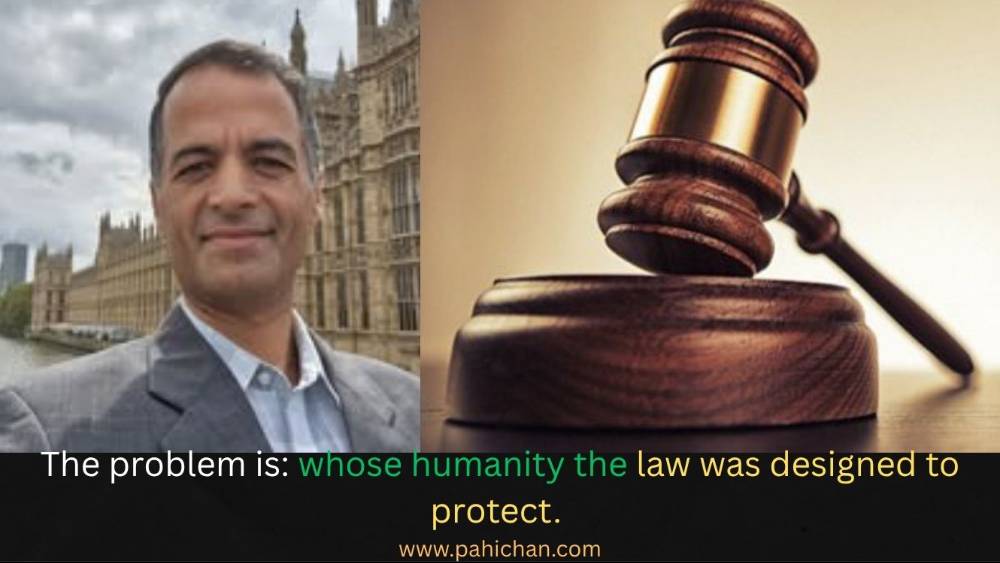
The problem is: whose humanity the law was designed to protect.


Copyright © All right reserved to pahichan.com Site By: Sobij.
