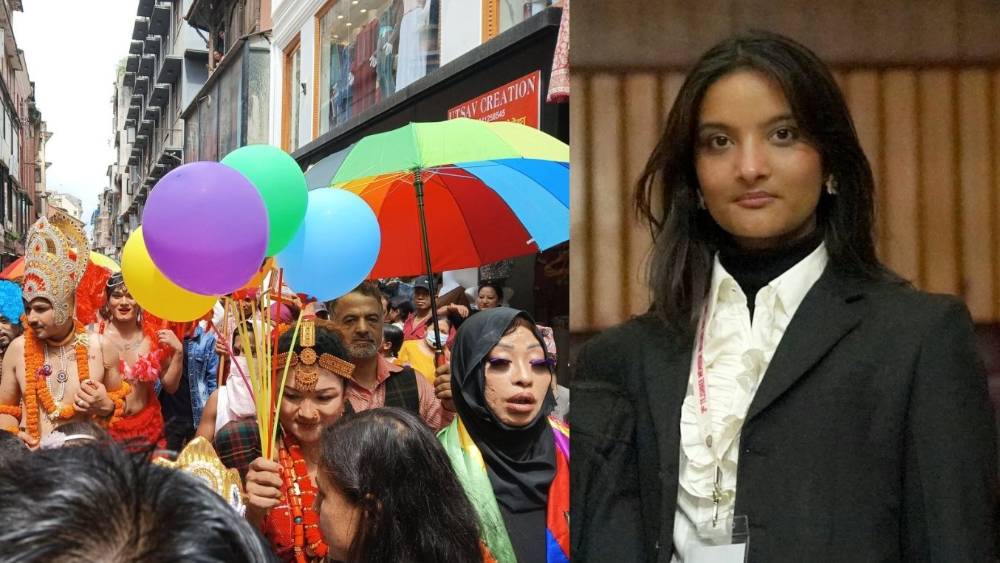
In recent months, social media in Nepal has seen a disturbing wave of trolling and suspicion directed at young Gen-Z leaders, including Tanuja Pandey and Rakshya Bam. Their international connections, participation in programmes and exposure to foreign organisations have been presented by some commentators as evidence that they are “foreign agents” working against Nepal.
This is a serious allegation.
And serious allegations require serious evidence.
I think we need to be much more careful before calling young Nepalis “foreign agents” simply because they have attended a conference, received a scholarship, participated in training, worked with an international organisation or interacted with a foreign embassy.
Many young Nepalis take these opportunities in good faith.
Nepal is a country where the state has not been able to provide sufficient opportunities for education, employment, professional development and international exposure. A young Nepali who goes to Saudi Arabia for work does not automatically become a Saudi agent. Someone who studies in India or China on a scholarship does not become an Indian or Chinese agent. A Nepali who attends a European conference does not automatically become a European agent.
Historically, thousands of Nepali young men joined the British and Indian armies because those opportunities offered employment and a livelihood that Nepal could not provide. Their participation did not automatically make them British or Indian agents.
Why should we apply a different standard to today’s young people?
If Tanuja, Rakshya or other young activists participated in programmes promoting democracy, accountability, transparency, human rights, political participation or opposition to corruption, that alone is not evidence that they are working for a foreign government against Nepal.
If someone has evidence that a particular person is actually acting on behalf of a foreign government or intelligence apparatus, present that evidence.
But a conference photograph is not evidence.
A scholarship is not evidence.
A training certificate is not evidence.
An international friendship is not evidence.
A meeting with a diplomat is not evidence.
A foreign-funded programme is not, by itself, evidence that its participants are foreign agents.
We should not destroy the reputation of a generation of young Nepalis on the basis of association.
But that does not mean we should be naïve.
A. Foreign influence is real—but influence is not the same as an agent
There is another side of this conversation that we should not avoid.
Foreign governments, donors, international organisations and geopolitical powers obviously have interests in Nepal.
Nepal sits between two major powers. It has strategic geography, economic importance and growing geopolitical significance. Foreign influence can operate through governments and political parties, but it can also operate through development assistance, civil society, research, media, professional networks, cultural programmes, scholarships, conferences and political training.
Sometimes influence is direct.
Often it is not.
A donor does not necessarily need to tell an organisation, “Do this.”
Funding priorities can influence what gets discussed.
Reporting requirements can influence the language organisations use.
International conferences can influence which issues receive visibility.
Professional networks can influence who becomes recognised as a leader.
And terminology can influence how an entire generation understands its own society.
None of this automatically means there is a conspiracy.
It is simply how institutional influence works.
Every donor has priorities.
Every government has interests.
Every international institution has a worldview.
Every programme has assumptions.
The question is whether we, as Nepalis, have enough confidence to engage with those influences critically.
B. I know this because I have lived inside this system
I have spent more than two decades working in civil society. I have benefited from international conferences, fellowships, training programmes and donor support. I have met diplomats, international activists, development agencies and civil-society leaders from many parts of the world.
Many genuinely believe in democracy and human rights. Many genuinely want to support Nepal. Some became close friends. I remain grateful for much of that solidarity.
But my experience also taught me something uncomfortable.
International solidarity can become complicated when you stop agreeing with the framework of those offering the solidarity.
For me, this became particularly clear around the question of gender. I increasingly argued that Nepal’s own third-gender traditions, histories and Eastern understandings should not simply disappear inside an international LGBTIQ+ framework.
I was not rejecting human rights. I was asking whether human rights required us to abandon our own language and history.
Over time, some relationships changed. Some invitations disappeared. Some collaborations became more difficult. I cannot say that every lost opportunity was because of one donor or one particular ideology. I cannot prove that, and I do not claim it.
But I know what it feels like when an international movement that once celebrated you becomes less comfortable with you because you insist on a different interpretation.
That experience has stayed with me.
The lesson I took from it is not that young Nepalis should avoid international engagement. Quite the opposite.
It is that we should enter the world with our own intellectual confidence.
C. Take the opportunity—but do not surrender your independence
There is nothing wrong with a Nepali young person accepting an international opportunity.
Take the scholarship.
Attend the conference.
Go to Oslo.
Go to London.
Go to Geneva.
Go to Brussels.
Go to Washington.
Go to Delhi. Go to China. Go to SouthAfrica, Brazil…
Learn how other societies work.
Meet people.
Build networks.
Bring knowledge home.
Nepal needs internationally exposed young people.
But there is one condition that I would consider essential:
Never exchange your intellectual independence for international acceptance.
The real test of independence does not come when you agree with your international partners.
It comes when you disagree with them.
Today, Tanuja or Rakshya may be invited because they represent a new generation of Nepali democratic voices.
But what happens tomorrow if they say:
“Our democracy should reflect Nepal’s own historical and social characteristics.”
What happens if they say:
“We support democracy, but we don’t believe every Western model of democracy can simply be transplanted into Nepal.”
What happens if they say:
“We support accountability, but we want Nepali approaches to accountability.”
What happens if they say:
“Our understanding of gender diversity comes from our own communities and history as well as from international human-rights discourse.”
What happens if they say:
“This international terminology does not adequately describe our people.”
What happens if they say:
“We disagree with this campaign.”
What happens if they(Tanuja and Rakshya) refuse to repeat somebody else’s political language?
I hope nothing happens.
I hope their international partners respect them even more.
Because that is where genuine independence is tested.
This is not a prediction about Tanuja or Rakshya.
It is simply advice based on experience.
D. The same question applies to democracy
This is not only about gender.
It applies to democracy too.
Nepal should learn from democracies everywhere.
We should study parliamentary systems, federalism, decentralisation, constitutional rights, independent institutions, transparency, accountability and democratic participation.
But Nepal’s democracy does not have to become a photocopy of another country’s democracy.
Nepal has its own history.
Its own communities.
Its own social structures.
Its own traditions of collective decision-making.
Its own political experience.
Its own understanding of community and responsibility.
A Western democracy may offer valuable lessons.
So may India.
So may China.
So may other Asian societies.
But ultimately Nepalis have to decide what kind of democratic system works for Nepal.
E. We should also distinguish between participating in a protest and organising political action
This distinction has become particularly important after the Gen-Z movement.
It is one thing for a young person to see a protest announcement on social media, pick up a placard and go into the street because they are angry about corruption, censorship or injustice.
It is another thing to organise a movement.
It is another thing to administer communication channels.
It is another thing to coordinate thousands of people.
It is another thing to participate in private online discussions about strategy, protest tactics, political demands and what happens after the government falls.
Those are different levels of political participation.
This does not mean that everyone involved in organising a protest is part of a conspiracy.
Quite the opposite.
We need to understand these different levels precisely before making accusations.
The evidence now available about Nepal’s 2025 Gen-Z protests demonstrates why this distinction matters. Investigations found that Discord became a major organisational space for the movement. The Kathmandu Post analysed more than 114,000 messages from two major servers over roughly 50 hours and reported that discussions initially focused heavily on peaceful protest but later included conversations about vandalism, arson and weapons.
A separate investigation by the National Human Rights Commission reported in 2026 that technology had been systematically misused during the protests and found evidence suggesting that peaceful protest preparations and preparations for destructive activities were occurring in parallel.
That deserves investigation.
But even here, we must resist the temptation to turn complexity into conspiracy.
The fact that some people discussed destructive acts online does not mean every protester was involved.
And the fact that a young activist participated in a protest does not automatically tell us what role they played in organising it.
Evidence must establish those distinctions.
F. Rakshya’s own experience illustrates the complexity
Reporting on the Gen-Z movement has described Rakshya Bam as helping coordinate the September 8 protest while explicitly calling for people not to vandalise property, set fires, threaten people or create chaos. The same reporting describes how the situation later moved beyond what organisers could control.
That is precisely why we should be careful.
A person can participate in organising a protest and still oppose violence.
A movement can begin peacefully and later become violent.
A digital platform can be used for democratic mobilisation and simultaneously become a place where destructive plans circulate.
There can be multiple groups inside the same movement.
There can be genuine protesters, opportunists, criminals, political actors, foreign observers, online trolls and ordinary citizens all occupying the same digital space.
Reality is rarely as simple as “these people organised everything” or “everything was spontaneous.”
G. Tanuja’s international involvement also deserves evidence, not innuendo
Tanuja Pandey has publicly explained her involvement with the EU Youth Sounding Board and defended it as a consultative platform rather than a mechanism for political control. She has also said that members have at times criticised EU investments and suggested alternative priorities, which she says were taken seriously. The Himalayan Times reported that she had faced intense online trolling over her affiliation.
That does not prove that every criticism of her is wrong.
It does demonstrate something important:
Her international association should be examined through evidence about what she actually did, not through assumptions about what someone imagines she must have done.
That is the standard we should apply to everyone.
H. Civil society can be influenced without being a conspiracy
I have worked in civil society long enough to know that influence can be subtle.
Sometimes donors encourage particular campaigns.
Sometimes they prefer particular terminology.
Sometimes they prioritise particular communities.
Sometimes they encourage organisations to use particular international frameworks.
Sometimes organisations that follow donor priorities find it easier to secure funding.
And sometimes organisations that challenge those frameworks find funding more difficult.
This does not mean every donor is malicious.
It does not mean every NGO is compromised.
It does not mean every activist is manipulated.
It means funding relationships have power.
We should be mature enough to discuss that power without turning the discussion into a conspiracy theory.
I. Donors should also ask themselves difficult questions
International donors who genuinely believe in inclusion should welcome these questions.
Are we funding local organisations or reproducing our own institutional priorities through them?
Are we listening to communities or merely looking for organisations that already speak our language?
Are we recognising indigenous concepts or translating everything into international categories?
Are we giving space to third-gender communities as they define themselves?
Are we funding local research into local histories?
Are we prepared to support an organisation that disagrees with our preferred framework?
Can a Nepali partner say “no” and remain a partner?
These are not anti-donor questions.
They are questions about meaningful partnership.
j. And Nepali civil society must ask itself the same questions
We should also look inward.
Nepali organisations should disclose their funding.
They should explain their objectives.
They should make their partnerships transparent.
They should tell communities what donors expect.
They should distinguish donor priorities from community priorities.
And they should have the courage to tell donors:
“This may work somewhere else, but it does not work here.”
That is what genuine local ownership means.
K. We should not make young Nepalis pay the price for Nepal’s geopolitical anxieties
There is a danger that ordinary young people will become collateral damage in a much larger geopolitical argument.
Nepal has real geopolitical vulnerabilities.
Foreign powers have real interests.
Some International organisations have real agendas.
Political parties have real relationships with external actors.
Government institutions, bureaucracy, business networks and security establishments can all be relevant to understanding foreign influence.
If we want to investigate foreign interference, those structures deserve serious scrutiny.
Why focus primarily on a young woman who attended a conference?
Why focus on a young activist who received a fellowship?
Why focus on someone who travelled abroad for training?
If a foreign power is attempting to shape Nepal’s politics, there are many levels at which such influence could potentially operate.
Young people should not automatically be treated as the weakest link simply because they are internationally connected.
L. Take the opportunity—but know what you are taking
My message to Tanuja, Rakshya and the wider Gen-Z generation is therefore not “stay away from foreigners.”
It is the opposite.
Go.
Learn.
Travel.
Study.
Attend the conference.
Take the scholarship.
Meet international activists.
Talk to diplomats.
Learn how other democracies function.
Listen to people who disagree with you.
But ask questions.
Who is funding this?
Why?
What is the objective?
What assumptions are built into the programme?
What language are we being encouraged to use?
Whose history is being taught?
Whose history is missing?
What happens if I disagree?
Can I criticise the donor?
Can I say that the Western model does not fit Nepal?
Can I defend a Nepali cultural framework?
Can I say that our third-gender traditions are not simply another translation of Western transgender identity?
Can I say that Nepal’s democracy must develop its own character?
If the answer to all those questions is yes, then international cooperation can become genuinely transformative.
M. The real test of friendship is disagreement
I have lost international friendships and opportunities because I refused to stop asking these questions.
I do not want today’s young people to repeat that experience.
But neither do I want them to be frightened of international engagement.
The world is too interconnected for isolation.
The answer is not to close Nepal’s doors.
The answer is to open the doors while keeping our own intellectual foundations.
A confident Nepali can learn from America without becoming American.
A confident Nepali can study in India without becoming Indian.
A confident Nepali can train in China without becoming Chinese.
A confident Nepali can attend a European conference without becoming European.
A confident Nepali can work with an international human-rights organisation without surrendering the right to disagree with it.
And a confident Nepali can say:
“I respect your democracy, but I will help build Nepal’s democracy.”
“I respect your gender framework, but I will also defend Nepal’s gender history.”
“I appreciate your support, but I will not outsource my judgment.”
That is the kind of international engagement Nepal needs.
N. Let us defend young people without becoming naïve
So, to those attacking Tanuja, Rakshya and other young Nepalis online, I would say this:
If you have evidence, present it.
If you have documents, show them.
If you have financial records, examine them.
If you have proof of instructions from a foreign government, bring it forward.
If you have evidence of an actual foreign intelligence relationship, investigate it.
But do not turn a scholarship into espionage.
Do not turn a conference into treason.
Do not turn an international friendship into evidence of disloyalty.
And do not turn an entire generation of internationally exposed young Nepalis into suspects.
At the same time, to Tanuja, Rakshya and the young activists themselves, I would say:
Be mindful.
Foreign interests are real.
Donor priorities are real.
Cultural influence is real.
Institutional incentives are real.
And sometimes people can be influenced without even realising it.
So learn from everyone—but retain your ability to say no (or yes if appropriate).
O. Nepal needs neither blind nationalism nor blind internationalism
We need something more difficult.
We need confidence.
Confidence to learn from the world.
Confidence to criticise the world.
Confidence to accept assistance.
Confidence to reject what does not fit.
Confidence to defend universal human dignity.
And confidence to say that universal dignity does not require every society to become culturally identical.
I have no interest in protecting Nepal from knowledge.
I want Nepal to become a producer of knowledge.
I do not want our young people to stop attending international conferences.
I want them to go to those conferences and return with enough confidence to challenge the conference itself.
I do not want Nepal to reject international human-rights language.
I want Nepal to contribute its own language to the global human-rights conversation.
I do not want young Nepalis to stop accepting international support.
I want them to use that support without surrendering ownership.
And I certainly do not want Tanuja, Rakshya or anyone else to be branded a foreign agent without evidence.
But I do want them—and all of us—to remain mindful of the power that comes with money, access, language, networks and international recognition.
Because foreign influence should be questioned without young Nepalis being scapegoated.
Both things can be true.
And perhaps the most important democratic freedom of all is this:
To learn from the world without becoming subordinate to it.
To accept solidarity without surrendering sovereignty.
To participate globally without forgetting who we are.
Copyright © All right reserved to pahichan.com Site By: Sobij.
