
To the rich countries that polluted the planet: Stop lending us money to clean up the disaster you helped create.
Nepal is not simply facing a climate crisis.
Nepal is living through its consequences.
Glaciers are melting. Rivers are becoming increasingly destructive. Floods and landslides are wiping out homes, infrastructure, farms and livelihoods. Families are being torn apart. Children are being left without parents.
And after all this, what does the international financial system offer a country like Nepal?
Another loan.
That is not climate justice.
It is an insult to the victims.
A. A child can tell you what climate change really means
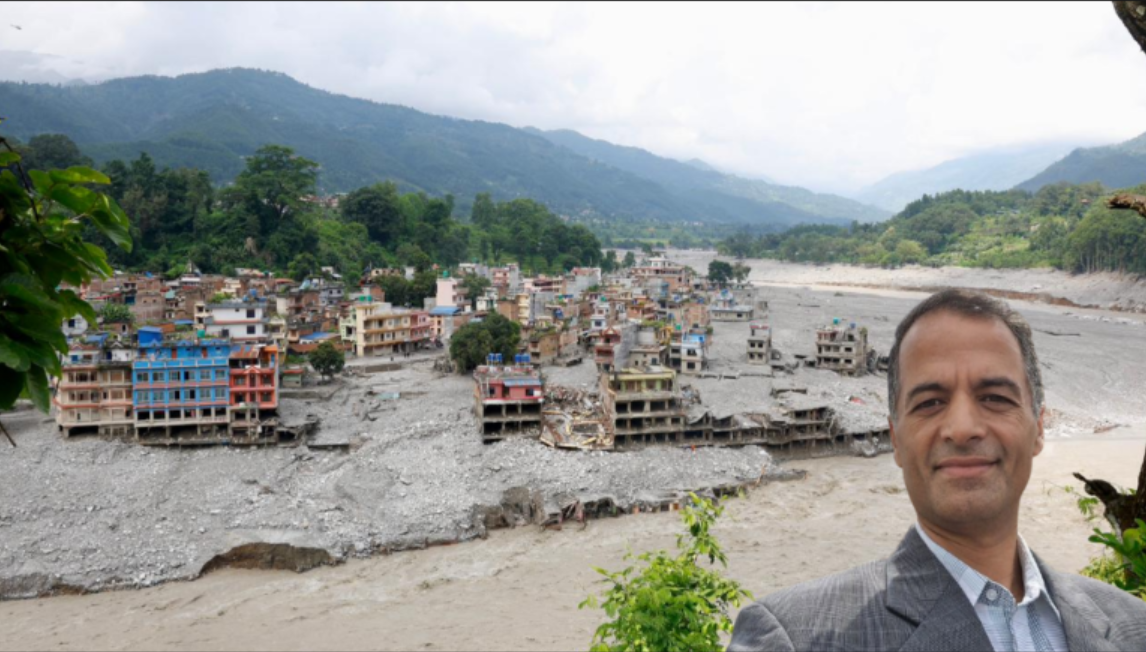
Look at Betrawati in Rasuwa.
A small rescue team to distribute some relief materials there told me that hundrads of bodies may still be buried beneath the river sediment. Almost every family appears to have suffered loss. In some places, entire families have been wiped out. Some people are still searching for their missing sons and daughters, brothers and sisters, husbands and wives, hoping against hope that their loved ones might still be found.
The scale of the disaster remains enormous. Recent reports describe entire communities destroyed, hundreds of deaths and thousands of people missing, while thousands of children have been affected across the worst-hit districts.
And then there are the children.
Children who survived—but whose world did not.
Many were at school when the disaster struck. They survived because they were away from the river, while their parents were working in fields, running shops or going about their daily lives.
Now these children are terrified of the river.
Even after reaching a physically safer place, they do not feel safe.
The sound of running water can trigger fear. A sudden loud noise makes them jump. Many struggle to sleep at night. Their minds remain trapped in the moment when their lives changed forever.
They are alive.
But the life they knew is gone.
At Nilkantha Secondary School alone, there is an initial estimate that around 150 children may have lost both their mother and father. We still do not have a complete, verified figure for Betrawati.
But behind every number is a child.
A child who needs much more than a packet of food.
A child who needs a home.
Education.
Healthcare.
Psychosocial support.
Security.
And, above all, someone who will stay.
B. Are we prepared to stay after the cameras leave?
Our emotions rise like a storm immediately after a disaster.
But storms of public attention disappear quickly.
Within a week, today’s tragedy can become yesterday’s news.
So we must ask ourselves:
Can we do more than send emergency supplies?
Can we sponsor a child who has lost both parents so that they have food, shelter and education at least through Grade 12?
Can we provide long-term guardianship and support?
Can we make sure these children receive psychological and emotional care?
And can we stop turning vulnerable children and grieving families into content for social media—posing for photographs, posting their personal stories and exposing their identities simply to demonstrate that we have helped?
Disaster victims are not publicity material.
Children are not fundraising props.
Their grief is not our social-media content.
What these children need is not our pity for one week.
They need people who will stand beside them for years.
Imagine if 150 people stepped forward and said:
“I will stand with one of these children until they complete Grade 12.”
Not for a photograph.
Not for a Facebook post.
Not for one food package.
But for years.
That is what genuine solidarity looks like.
C. What happens when the relief trucks leave?
This is where the climate-justice conversation must begin.
Because disaster relief is only the first response.
What happens six months later?
What happens two years later?
Who pays for rebuilding?
Who pays for schools?
Who pays for psychosocial care?
Who pays for safer settlements?
Who pays when families lose their livelihoods?
And who pays when a poor country has to borrow money to rebuild infrastructure destroyed by a climate crisis it barely contributed to creating?
Nepal’s public debt is already enormous.
Yet countries with vastly greater historical emissions continue to announce billions in climate finance, while vulnerable countries like Nepal remain trapped in a system where development and climate finance can add to their debt burden.
This is fundamentally unjust.
Nepal did not build its prosperity by burning massive quantities of coal, oil and gas.
Nepal did not fill the atmosphere with the carbon that is destabilising the climate.
The World Bank itself has described Nepal as a negligible contributor to global climate change, producing about 0.1% of global greenhouse-gas emissions.
Yet Nepal is paying the price.
And the price is not merely measured in rupees.
It is measured in:
children without parents.
families without homes.
farmers without land.
communities without livelihoods.
and human beings who are afraid to sleep when they hear the river.
D. Nepal’s foreign debt: NPR 1.6 trillion—and billions leaving the country every year
Nepal’s public debt is no longer some distant economic statistic discussed only by economists.
It affects our ability to respond to disasters.
At the end of fiscal year 2025/26, Nepal’s external public debt had reached approximately NPR 1.60 trillion, accounting for 53.77% of the country’s total public debt. Total public debt had reached approximately NPR 2.97 trillion.
And this debt has a very real annual cost.
In FY 2025/26, Nepal paid approximately NPR 74.28 billion to service its external debt alone.
That included:
NPR 61.84 billion in principal repayments; and
NPR 12.44 billion in interest payments.
That is approximately NPR 6.2 billion every month, on average, going toward external debt service.
Think about that number in the context of a country struggling to rebuild after climate disasters.
NPR 74.28 billion is not an abstract accounting figure.
It represents resources that could potentially be used for safer bridges, early-warning systems, climate-resilient infrastructure, schools, hospitals, watershed protection, disaster preparedness and recovery.
And there is an even deeper injustice here.
Why should Nepal continue transferring billions of rupees every year to service external debt while simultaneously having to seek additional financing to cope with increasingly devastating climate disasters?
This is precisely why Nepal needs a Debt-for-Climate-Justice Swap.
If a significant portion of Nepal’s eligible external debt were cancelled, restructured or converted into climate investments, resources currently committed to debt servicing could instead be directed toward resilience and recovery.
Imagine redirecting billions of rupees from:
debt servicing to climate adaptation;
interest payments to disaster recovery;
debt repayment to children’s futures.
That is the economic logic of climate justice.
And this is not an argument that Nepal should simply refuse to repay legitimate debts.
It is an argument that the international financial system must recognise a new reality:
A country facing climate destruction should not be pushed deeper into debt to repair damage it did not disproportionately cause.
E. This is why Nepal needs a Debt-for-Climate-Justice Swap
Nepal should demand a fundamentally different approach.
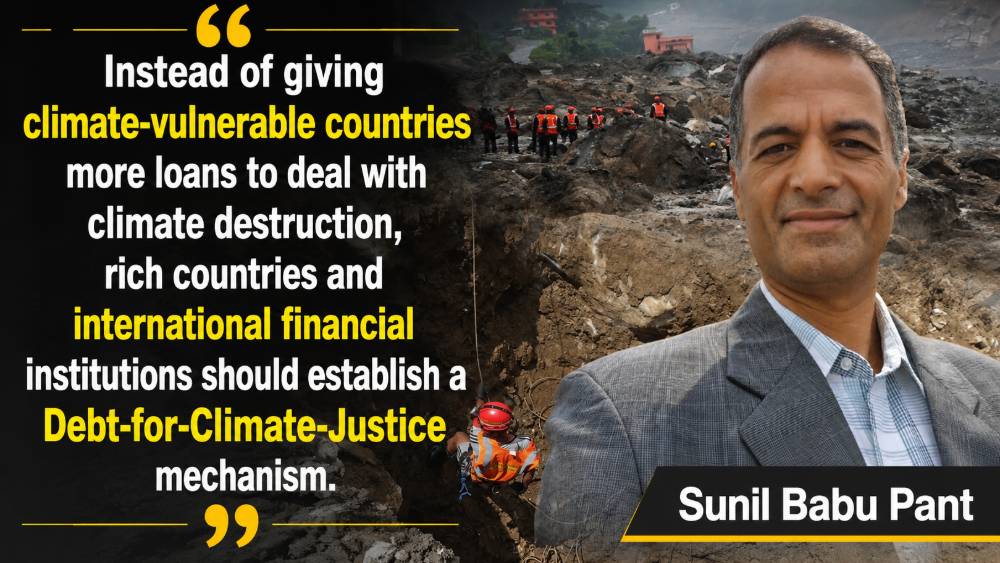
Instead of giving climate-vulnerable countries more loans to deal with climate destruction, rich countries and international financial institutions should establish a Debt-for-Climate-Justice mechanism.
Eligible portions of Nepal’s external debt should be cancelled, restructured or converted into long-term climate investments.
The money that would otherwise be spent servicing debt should instead be directed toward:
climate-resilient infrastructure;
disaster recovery and reconstruction;
glacier and watershed protection;
early-warning systems;
climate-resilient agriculture;
relocation of communities facing extreme climate risks;
schools and hospitals;
psychosocial support for disaster-affected children;
protection of Himalayan ecosystems; and
long-term recovery for families who have lost their homes and livelihoods.
That is not charity.
That is responsibility.
Debt-for-development and debt-for-climate mechanisms are not some impossible fantasy. International financial institutions already recognise debt swaps as mechanisms for reducing debt-service pressures while directing resources toward development and climate objectives.
So the question is not:
Can this be done?
The question is:
Why isn’t it being done at the scale demanded by the climate crisis?
F. The children of Betrawati should change the global climate-finance conversation
Imagine if 150 people stepped forward and said:
“I will stand with one of these children until they complete Grade 12.”
Not for a photograph.
Not for a Facebook post.
Not for one food package.
But for years.
Imagine if governments made the same commitment at a much larger scale.
Imagine if the billions currently structured as loans were converted into grants and debt relief for climate-vulnerable communities.
Imagine if the international community said:
“You did not cause this crisis. You will not be pushed deeper into debt because of it.”
That would be climate justice.
Because these children did not choose the climate crisis.
They did not burn fossil fuels.
They did not build economies on centuries of carbon-intensive industrialisation.
They did not cause glaciers to melt.
They did not cause extreme weather.
Yet they are living with the consequences.
Why should their future be mortgaged to pay for a disaster they did not create?
G. To the rich countries: You cannot pollute, profit—and then lend to the victims
For decades, industrialised economies accumulated enormous wealth through fossil-fuel-driven development.
The benefits were privatised.
The emissions were globalised.
And now the consequences are being disproportionately experienced by poorer and more vulnerable countries.
The moral equation cannot be:
You pollute → we suffer → you lend → we repay.
It must become:
You contributed disproportionately → you have greater responsibility → you provide grants, compensation and debt relief → we rebuild with resilience.
The principle is simple:
Those who contributed most to the climate crisis must contribute most to solving it.
This is not anti-development.
It is not anti-Western.
It is not anti-globalisation.
It is an appeal for fairness in the global financial system.
Rich countries have the greatest capacity to act.
They also carry a disproportionate historical responsibility.
Their response should therefore be proportionate.
Climate justice cannot mean asking the poorest countries to become more indebted so that they can survive the consequences of global warming.
H. And to the World Bank
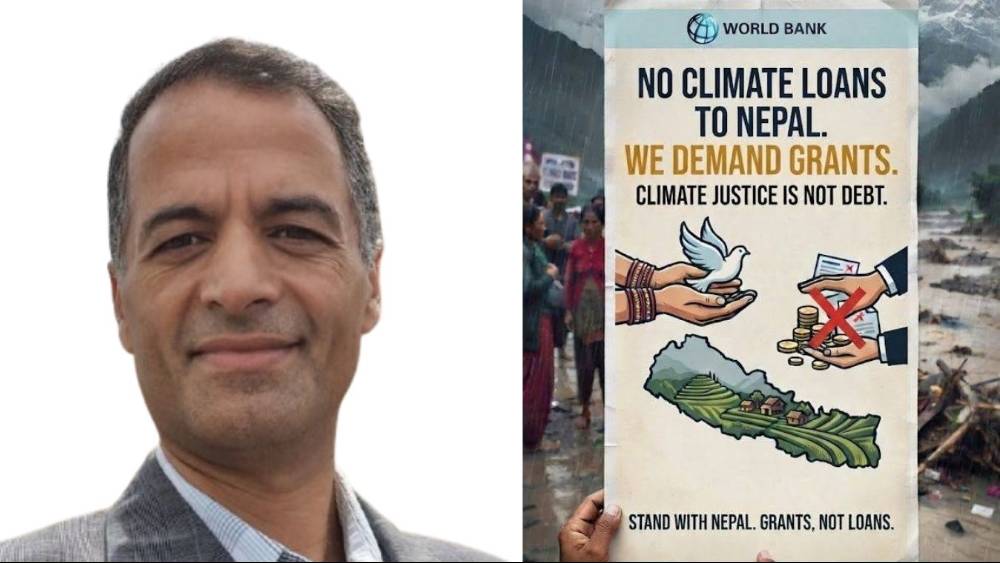
The world Bank has offered a grant and soft loan about 25million USD again after this disaster.
The World Bank has repeatedly acknowledged Nepal’s extraordinary climate vulnerability. It has also recognised that Nepal’s contribution to global greenhouse-gas emissions is negligible.
So I have a simple question for the World Bank:
Why should Nepal have to borrow its way out of a crisis it barely helped create?
Do not tell Nepal’s climate victims to borrow their way out of a disaster.
Do not call another loan “climate finance” simply because it carries a climate label.
Do not measure your success by how much money you can lend to vulnerable countries.
Measure it by how many lives you can help rebuild without creating another generation of debtors.
If debt can be restructured for financial stability, it can be restructured for climate justice.
If debt swaps can be used to protect forests and biodiversity, they can be used to protect climate-vulnerable people.
If the international financial system can mobilise enormous resources when financial institutions are in crisis, it can mobilise resources when human beings, communities and ecosystems are in crisis.
The World Bank should lead—not resist—the creation of a genuine Global Debt-for-Climate-Justice Facility.
And Nepal should be one of its first beneficiaries.
I. Nepal does not need pity. Nepal needs justice.
Nepal does not need another debt repayment schedule.
Nepal needs debt relief.
Nepal does not need climate loans.
Nepal needs climate grants and loss-and-damage finance.
Nepal does not need another international conference where vulnerable countries are praised for their resilience.
Nepal needs the resources to stop having to be resilient to injustices created elsewhere.
And the children of Betrawati do not need another photograph.
They need a future.
The question is no longer whether Nepal can afford climate action.
The question is whether the world can afford climate injustice.
Because every time a child loses a parent, every time a village is swept away, every time a farmer loses a lifetime of work, and every time a vulnerable country is forced to borrow again to rebuild after a climate disaster, the world is accumulating another kind of debt.
A moral debt.
Nepal’s financial debt can be measured in trillions of rupees.
But the world’s climate debt to Nepal cannot be measured so easily.
It is measured in:
lost lives,
lost childhoods,
lost homes,
lost futures,
and lost hope.
The international community must finally decide which debt it intends to repay.
Nepal should not be made to borrow money to survive a crisis it did not create.
Cancel the debt.
Fund the recovery.
Make the polluters pay.
Turn debt into climate justice.
Because the children of Betrawati are not asking the world for charity.
They are asking for the right to have a future.
And the world should be ashamed if its answer is:
“Here is another loan.”




Copyright © All right reserved to pahichan.com Site By: Sobij.
