
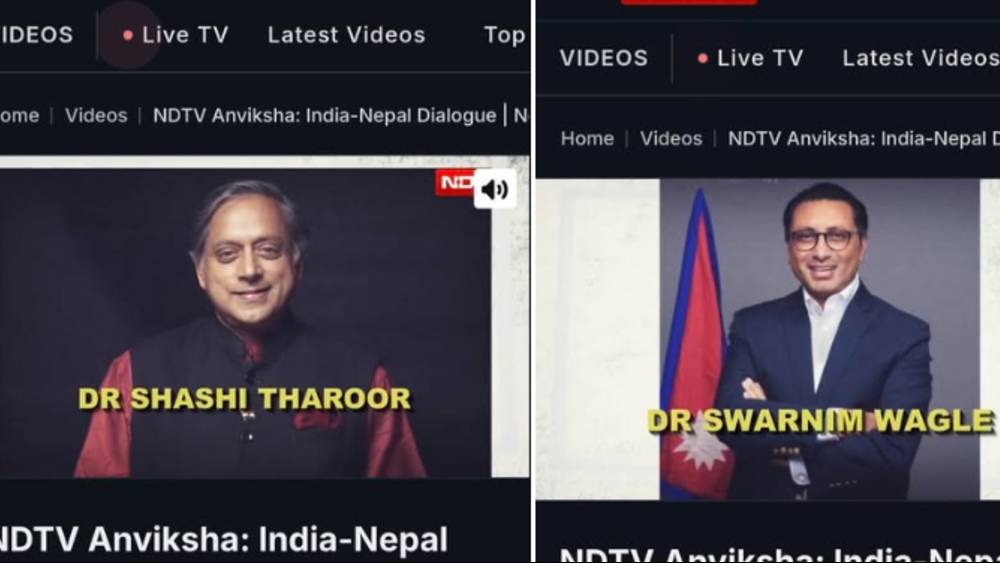
Shashi Tharoor was in Kathmandu this week. Swarnim Wagle was there too. And at NDTV’s Anviksha: Ideas Across Borders, Wagle was presented as “Nepal’s Shashi Tharoor.”
At first glance, it sounds flattering.
Two accomplished South Asians. Two highly educated public figures. Two people who have built impressive careers in international institutions and public life.
But there was something deeply revealing about the comparison.
It was not primarily about who understands India and Nepal better. It was not about who has a more compelling vision for the future of the region. It was not about who has better answers to the enormous problems facing ordinary Indians and Nepalis.
A significant part of the fascination was about English—the sophistication of their vocabulary, their elaborate sentences and their ability to use unusually complicated English words.
And I cannot help asking:
Is this really what an India–Nepal dialogue has come to?
Two ancient societies, sharing centuries of history, culture, religion, migration, trade, rivers, borders and family connections—and our intellectual celebration becomes a competition over who can speak the most sophisticated English?
Perhaps we need to look more carefully at what is happening here.
Tharoor’s career at the United Nations, in Indian politics, diplomacy and literature is impressive.
Wagle’s journey through Budhanilkantha School, the London School of Economics, Harvard, the Australian National University, the World Bank, UNDP, Nepal’s National Planning Commission and now the Finance Ministry is equally remarkable.
They have worked hard. They have demonstrated considerable intellectual ability.
But their accomplishments raise an uncomfortable question that we rarely dare to ask:
How much of that success was made possible because they mastered the language and institutions of the global English-speaking establishment?
Would the World Bank have discovered Swarnim Wagle if he had been educated entirely in Nepali?
Would the United Nations have opened the same doors to Shashi Tharoor if he had grown up without elite English education?
Would their books, ideas and speeches have travelled globally in the same way?
Would they have had the same opportunities?
That is the question.
And asking it is not an attack on them.
It is an attack on a system that has made English such a powerful gatekeeper to recognition, influence and success.
1. English is not simply a language in South Asia
This is where India’s postcolonial societies need to be honest with ourselves.
English is not merely a language.
It has been established as social capital.
It has been establiahed as class marker.
It has been established as an employment advantage.
It has been established as an educational advantage.
It has been established as a passport into elite institutions.
It has been established as the language of international development, diplomacy, academia, global media and organisations such as the UN and World Bank.
A young Nepali can be exceptionally intelligent, creative and knowledgeable. But if that young person cannot speak sophisticated English, the doors available to him or her can be dramatically fewer.
Meanwhile, someone who masters elite English can move comfortably between Kathmandu, Delhi, London, Geneva, Washington and New York.
The language opens the door.
Then the university opens another.
Then the professional network opens another.
And eventually the person is celebrated simply as a “successful” individual.
Of course merit matters.
But access to the institutions where merit gets recognised matters too.
2. Imagine another Swarnim Wagle
Imagine an equally brilliant young Nepali.
Born in a remote village.
His or her first language is not English.
Perhaps not even Nepali.
Perhaps Maithili, Tamang, Tharu, Newar, Gurung, Magar, Bhojpuri or another indigenous language.
Imagine this person has an extraordinary understanding of Nepal’s economy because they have lived it.
They understand migration because their family survives on remittances.
They understand agriculture because they farm.
They understand poverty because they have experienced it.
They understand exclusion because they have lived it.
But they cannot speak polished English.
Would the World Bank recruit them?
Would Harvard notice them?
Would international development conferences invite them?
Would Kathmandu’s elite media call them an intellectual?
Would they ever reach the same platforms?
Maybe not.
But we know the odds are different.
And that difference is the colonial inheritance we need to confront.
3. Imagine if Tharoor had grown up without English
Now apply the same thought experiment to Tharoor.
Imagine he had grown up with extraordinary intellectual ability but without access to elite English education.
Imagine he wrote brilliantly in Malayalam.
Imagine he spoke eloquently in an Indian language but could not operate comfortably in the language of international diplomacy.
Would the United Nations have opened the same doors?
Would Western publishing houses have embraced him?
Would his ideas have travelled globally?
Would Indian media have celebrated his vocabulary?
Perhaps some of this would still have happened.
But almost certainly the pathway would have been harder.
That does not diminish Tharoor.
It reveals the power of the language.
And perhaps that is precisely the conversation people like Tharoor and Wagle should be leading.
4. The colonial project succeeded more deeply than we realise
The British eventually left South Asia.
But the hierarchy they helped establish did not disappear.
English became associated with intelligence.
Western education became associated with modernity.
Foreign degrees became associated with excellence.
English-speaking elites became interpreters of the modern world.
Local languages became associated with ordinary people.
Indigenous knowledge became “tradition.”
And people who could reproduce the language, accent and intellectual vocabulary of Western institutions were elevated above those whose knowledge came from lived experience.
The most successful part of colonialism may therefore be psychological.
The coloniser no longer needs to tell us that English is superior.
We tell ourselves.
Our parents tell their children:
“Learn good English if you want to be successful.”
Schools compete over English-medium education.
Employers treat English fluency as evidence of competence.
Television celebrates sophisticated English speakers.
Young people imitate accents.
And increasingly, the ability to use complicated English words becomes confused with intelligence.
That is how colonialism survives after colonial rule.
5. And this is why the “Nepal’s Shashi Tharoor” moment matters
Some may say: “What’s the problem? It was only a light-hearted comparison.”
That is precisely why it is worth discussing.
Colonial attitudes are rarely reproduced through dramatic declarations.
They are reproduced through everyday cultural signals.
Who is presented as sophisticated?
Who is called intellectual?
Whose accent is admired?
Whose vocabulary is celebrated?
Whose university degree is considered impressive?
Whose knowledge is placed on the main stage?
These apparently harmless choices shape the aspirations of young people.
If a major media organisation tells millions of young South Asians that one of the most interesting similarities between two successful public figures is their ability to use complicated English, what message does a 17-year-old in Kathmandu or Delhi receive?
Perhaps:
If I want to be successful, I must learn to sound like them.
Not:
I must understand my society.
Not:
I must know my history.
Not:
I must learn from my community.
Not:
I must solve real problems.
But:
I must speak impressive English.
That is a dangerous lesson.
What happened to the real questions?
The Anviksha platform could have been an extraordinary opportunity.
India and Nepal have enormous issues to discuss.
Why does Nepal remain so dependent on labour migration?
Why are millions of young South Asians leaving home to find dignity and employment elsewhere?
Why does Nepal have such a deeply unequal economic relationship with India?
How should Nepal balance its relationships with India, China and the wider world?
How can the two countries cooperate on energy, water, climate and disaster management?
What does an equal India–Nepal relationship actually mean?
What happens to Himalayan communities as climate change accelerates?
Why do our economies continue to produce educated young people for export rather than productive opportunities at home?
Why do caste, gender, class and geography still determine who gets heard?
These are the questions that could have connected India and Nepal.
Instead, we ended up talking about who resembles Shashi Tharoor in the ability to deploy sophisticated English.
What a missed opportunity.
6. The irony is that Tharoor himself understands this problem
There is an interesting irony here.
Tharoor has written about his own complicated relationship with Malayalam and about how his generation was increasingly oriented toward Westernised education and English-language culture.
He knows, perhaps better than many, how colonialism can reshape people’s relationship with their own language and culture.
So I would expect more from him.
Not less English.
Not an apology for being educated.
But a more conscious challenge to the hierarchy that makes English-speaking elites appear inherently superior.
And I would expect the same from Wagle.
He has travelled through precisely those elite international institutions that confer enormous authority on people who master their language and culture.
That makes him uniquely positioned to ask:
Why should a brilliant Nepali have to become fluent in elite English before the world takes their intelligence seriously?
7. And NDTV should know better
This criticism is also directed at NDTV.
A major media organisation has the power to shape public imagination.
It should know that language is never merely language.
When it repeatedly associates sophistication, intelligence and leadership with elite English performance, it reinforces a hierarchy that already deeply disadvantages millions of South Asians.
NDTV may not intend to promote colonial thinking.
But intention is not enough.
Cultural impact matters.
Mr. Tharoor, Mr. Wagle and NDTV should be aware that this kind of framing can reinforce the colonial mindset across India and Nepal—particularly among young people who are already being taught that English is the primary pathway to success.
8. I am not asking us to reject English
That would be absurd.
English is useful.
Learn it.
Master it.
Use it to communicate with the world.
Use it to access knowledge.
Use it to challenge powerful institutions.
Use it to build international solidarity.
But don’t worship it.
And don’t confuse it with intelligence.
A person who speaks perfect English is not necessarily wiser than someone who speaks imperfect English but perfect in his own mother tongue.
A Harvard graduate does not automatically understand Nepal better than a farmer from Humla.
A World Bank economist does not necessarily understand poverty better than the person living in poverty.
An international diplomat does not necessarily understand a border community better than the people who have lived on that border for generations.
And someone who knows the longest English words does not necessarily have the deepest ideas.
9. We need to decolonise success itself
Perhaps the real question is not:
“Why do Tharoor and Wagle speak such good English?”
It is:
“Why are we still so impressed by it?”
Why do we think sophistication must sound foreign?
Why do we believe that complicated language makes complicated thinking?
Why do we require our brightest young people to leave their linguistic and cultural worlds before we recognise their intelligence?
Why does knowledge become more valuable when it is translated into English?
Why is a Western university often treated as a certificate of intelligence, while thousands of years of indigenous knowledge are treated merely as culture?
These questions matter far more than who can utter the most complicated English word.
10. The India–Nepal dialogue we need
I would like to see another Anviksha.
Put Tharoor and Wagle on the stage.
But don’t ask them who speaks better English.
Ask them how India and Nepal can support eachother.
Ask them about migration.
Ask them about inequality.
Ask them about borders.
Ask them about climate.
Ask them about economic dependency.
Ask them about indigenous knowledge.
Ask them about the future of young people.
And then invite a farmer, a migrant worker, an indigenous elder, a woman entrepreneur, a young unemployed graduate and a community activist onto the same stage.
Let them speak in their own languages.
Provide translation.
And listen.
Perhaps then we would discover something important:
Intelligence does not belong to English.
Knowledge does not require an Oxford accent.
Wisdom does not need a Harvard degree.
And sophistication does not require a 20-letter English word.
The real measure of an intellectual is not how difficult a sentence they can construct.
It is how deeply they understand the world—and how effectively they can use that understanding to make the world better.
So, Mr. Tharoor, Mr. Wagle and NDTV, this is not a request to speak less English.
It is a request to think more critically about what your English represents.
You have mastered the language of the global establishment.
Now perhaps you can help dismantle the hierarchy that tells millions of young Indians and Nepalis that mastering that language is the price of being intelligent.
Because the British may have left South Asia decades ago.
But if our children still believe that they must learn to speak like the coloniser before they can become somebody, then perhaps the colonial mind is still sitting inside our classrooms, our television studios, our universities—and our own ambitions.
And that is a much bigger problem than who can say the biggest English word.



Copyright © All right reserved to pahichan.com Site By: Sobij.
