
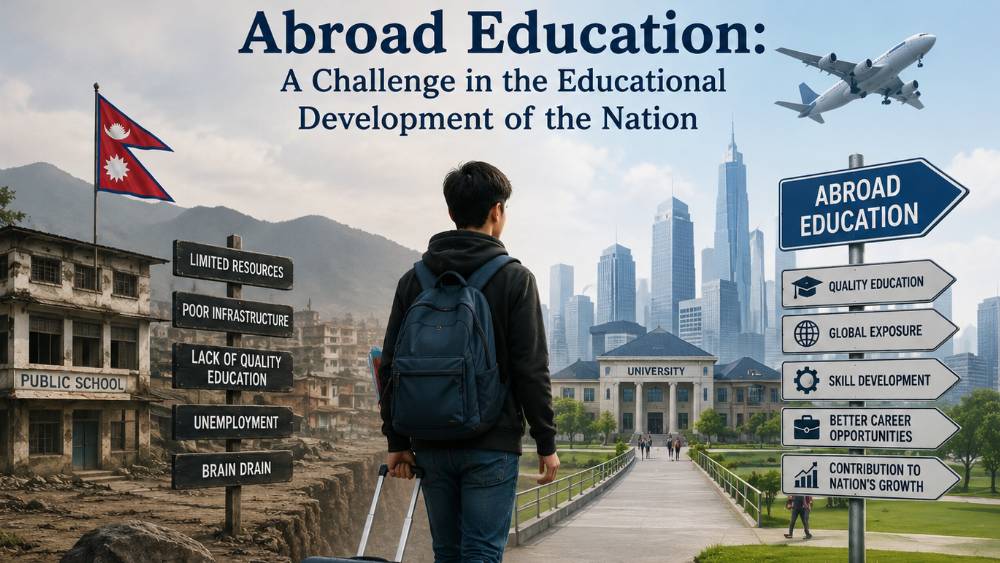
In Nepal today, the dream of studying abroad has become almost a culture among young people. For many students, completing +2 is immediately followed by preparations for IELTS, PTE, visa applications, and departure plans. Families proudly speak about sending their children to countries like Australia, the USA, the UK, Canada, or Japan, believing that foreign education guarantees a better future. To some extent, this belief is understandable. Abroad studies offer international exposure, quality education, better opportunities, and independence. However, while individuals may benefit from it, the nation itself is gradually facing the negative consequences of this growing trend.
A country develops through the contribution of its youth. Young people are the ones who work in industries, teach in schools, innovate in technology, serve in hospitals, run businesses, and create new ideas for society. But today, Nepal is losing a large portion of its energetic and capable youth before they can even contribute to the country. Every year, thousands of students leave immediately after completing school education. As a result, many sectors are facing shortages of skilled and active manpower. Villages are becoming emptier, colleges are losing students, and even businesses struggle to find committed workers. The nation slowly becomes dependent more on remittance than on its own productive strength.
Another serious problem is the decline in quality educated manpower within the country. Many of the brightest students leave Nepal with dreams of settling abroad permanently. In many cases, they never return. This creates a situation where Nepal invests in raising and educating talented individuals, but developed countries receive the benefit of their knowledge and skills. Doctors, engineers, teachers, researchers, and IT professionals who could have helped improve Nepal instead contribute to foreign economies. This continuous loss of capable people weakens the nation academically, economically, and socially.
I have personally felt the impact of this trend throughout my educational journey from ISc to MA level. Some of the most inspiring and knowledgeable teachers I encountered did not remain with us for long.
They entered classrooms with confidence, passion, and fresh ideas. Their teaching made students interested in learning and motivated us to think beyond textbooks. But after taking only a few classes, many of them left for foreign countries to pursue higher studies or better opportunities. Suddenly, classes became irregular, courses remained incomplete, and students were forced to adjust again with new teachers. As students, we felt disappointed because we were not just losing teachers; we were losing mentors who could have shaped our academic lives in a meaningful way. That experience made me realize how deeply the trend of foreign migration is affecting our education system itself.
Still, studying abroad is not entirely negative. Exposure to international education and global experiences can help students grow personally and professionally. The problem begins when foreign education becomes an obsession rather than a choice. Today, many students leave not because they have a clear academic goal, but because staying in Nepal feels like a sign of failure. This mindset is dangerous for both individuals and the nation.
One possible solution could be encouraging students to pursue foreign education only after completing their bachelor’s degree in Nepal. At a more mature stage, students can make better academic and career decisions. Completing undergraduate education inside the country would also help strengthen Nepali universities and maintain a healthier academic environment. Students would develop stronger roots in their own society before exploring opportunities abroad. Moreover, it provides opportunity to students to explore the society and its core as a mature youth not just as a growing teenager. This would instill in them a sense of belonging towards the society and plan and prepare themselves for being at service to the society during their study duration and after the completion as well.
At the same time, Nepal itself must improve. Students cannot be blamed entirely for leaving when they see limited opportunities, outdated educational systems, unemployment, and uncertainty at home. The government and educational institutions need to improve the quality of education, promote research and innovation, and create better career opportunities for young people. Teachers and skilled professionals should also be given respect, proper salaries, and professional growth so they feel encouraged to stay in Nepal.
Another important step would be creating policies that encourage students to return after their studies. Scholarships tied with national service, startup support for returning graduates, and opportunities in research and development could help transform brain drain into brain gain.
In conclusion, abroad education is both an opportunity and a challenge. It helps individuals dream bigger, but it also raises serious questions about the future of Nepal’s educational and developmental strength. A nation cannot progress if its classrooms, institutions, and workplaces continue losing their most capable people. The goal should not be to stop students from going abroad, but to create a balance where global learning ultimately contributes back to the nation. Only then can foreign education become not a loss for Nepal, but a source of national growth and transformation.





Copyright © All right reserved to pahichan.com Site By: Sobij.
