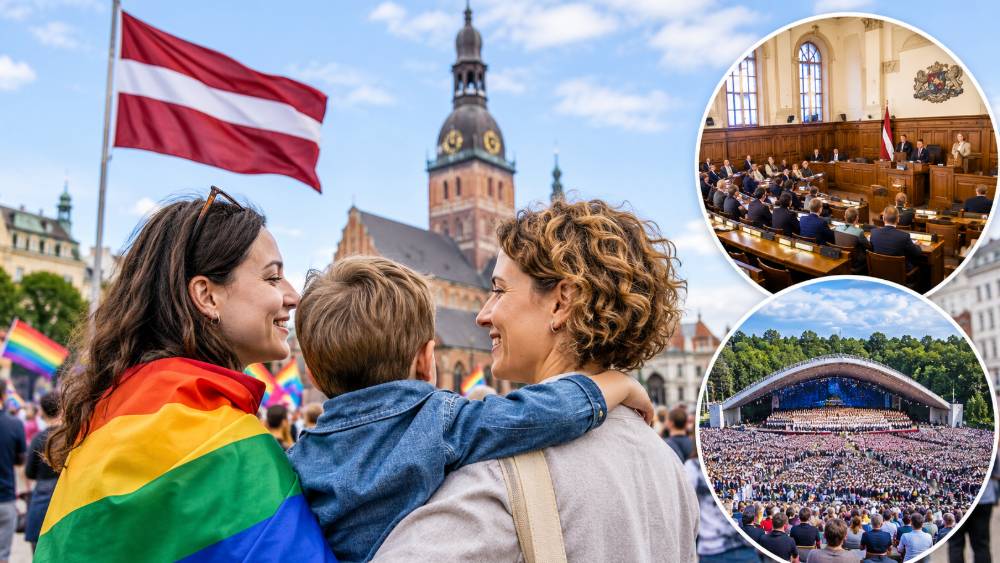
Court cases, parliamentary debates and political decisions expose the gap between Latvia’s international commitments and the everyday rights of LGBTQ+ families.
In 2023, Latvia’s parliament elected Edgars Rinkēvičs as the country’s president, making him one of the few openly gay heads of state in the world. A Latvian boy watching him take the oath of office in Riga could see an openly gay man become the country’s highest constitutional authority. Yet, under the country’s constitution, two men still cannot marry in a Latvian registry office.
Even the president himself would not be legally allowed to marry a man in his own country.
The contradiction between political representation and equal family rights has become increasingly visible in Latvia, where same-sex couples continue to face legal and administrative barriers despite the introduction of registered partnerships in 2024.
One of the latest cases concerns a child whose mother’s female partner is seeking legal recognition as his second mother.
The child’s biological mother and her partner had registered their partnership and were raising him together. An administrative court had already recognised the family relationship between the child and his biological mother’s partner. However, when they approached the municipal civil registry to have her recorded as a mother on the child’s birth certificate, the office refused.
On August 31, 2026, Latvia’s Constitutional Court opened case 2026-15-0103 concerning the refusal.
The family had registered their partnership, approached the courts and obtained judicial recognition of their relationship. Yet, that recognition was not enough to secure the second mother’s place on the child’s birth record.
The case has brought renewed attention to the legal position of children raised by same-sex couples and the practical consequences of Latvia’s restrictions on family recognition.
A mother or a neighbour?
The issue also reached Latvia’s parliament, the Saeima, during a debate on October 8, 2026.
Ramona Petraviča, a member of parliament from Latvia First, questioned whether a child’s birth certificate could list “a mother and a girlfriend, a neighbour and a mother.”
Her remarks referred to the possibility of recognising two women as mothers on a child’s birth certificate.
In the same parliamentary debate, Atis Švinka of the Progresīvie party raised a different question: who would be legally authorised to represent the child and make everyday decisions on the child’s behalf?
The two questions highlighted opposing concerns surrounding the same family. While one MP questioned the legitimacy of recognising two mothers, another focused on the child’s practical need for parental representation and legal protection.
Former Constitutional Court president and Saeima MP Gunārs Kūtris also said that asking for two mothers or two fathers to be listed on a birth certificate would “probably be foolish”. However, he acknowledged that parliament could neither order the Constitutional Court to abandon the case nor dictate its judgment.
The parliamentary motion concerning the Saeima’s position was submitted by ten MPs: Linda Liepiņa, Ramona Petraviča, Mārcis Jencītis, Ričards Šlesers, Ilze Stobova, Viktorija Pleškāne, Jekaterina Drelinga, Kristaps Krištopans, Edmunds Zivtiņš and Maija Armaņeva.
The motion was rejected, with 32 votes in favour, 27 against and 12 abstentions.
The controversy is not entirely new. In December 2022, during a debate on the Civil Union Bill, Petraviča compared a woman’s attempt to have her family recognised to a hypothetical woman from London who had married a chandelier.
On December 23, 2022, Latvia’s Ombudsman formally informed parliament that the analogy demeaned same-sex couples and relied on a discriminatory assumption about their ability to establish lasting relationships.
Couples can register partnerships but cannot marry
Latvia began registering partnerships in July 2024. By July 1, 2026, the national register had recorded 925 partnerships, including 314 same-sex couples.
However, the constitution continues to define marriage as a union between a man and a woman.
This constitutional restriction distinguishes Latvia from its northern neighbour Estonia, which introduced marriage equality on January 1, 2024.
The question of recognising marriages performed in another European Union country has also reached the European Court of Justice.
On March 24, 2026, Latvia’s Supreme Court referred a case concerning two Latvian citizens who married in Sweden and subsequently sought to have their marriage recognised in Latvia.
Both had their main residence in Latvia when they married. One spouse was a dual Swedish-Latvian citizen who had been born and raised in Sweden before moving to Latvia in 1997.
Latvian authorities refused to enter their marriage in the country’s civil register.
The Supreme Court has asked the EU Court of Justice to clarify how European free-movement law applies when citizens travel to another EU member state to marry without establishing a new residence there.
The case raises an important question about the rights of EU citizens who exercise their freedom to travel and marry abroad but return to a country that does not recognise their marriage.
In 2025, the EU Court of Justice had ruled in a case involving two Polish citizens who married in Germany that Poland was required to recognise their marriage for the purposes of EU law.
The Latvian referral now raises a related question about couples who travel to marry but do not relocate permanently.
A shared European railway, but unequal family recognition
The legal differences between European countries could also affect families travelling across borders.
Rail Baltica is being developed to connect the Baltic states with the wider European railway network using a common track gauge of 1,435 millimetres.
Consider a hypothetical Estonian same-sex couple who are legally married and travel from Tallinn to Riga with their child.
They can travel together, but questions may arise if the child needs medical treatment in Latvia. What documents would each mother need to establish her authority to represent the child and make decisions about medical care?
European law protects children’s rights to move with their parents in circumstances addressed by the European Court of Justice’s Pancharevo judgment. However, the practical documentation required by a Latvian hospital to authorise treatment is a separate issue.
The contrast is striking: European countries have established precise technical standards for cross-border railway connections, yet families can still face uncertainty over the legal recognition of their relationships and parental responsibilities.
LGBTQ+ people continue to face insecurity in public life
Legal recognition is only one aspect of the challenges faced by Latvia’s LGBTQ+ community.
A survey of 1,184 LGBTQ+ people conducted in Latvia in spring 2025 found that 45 per cent felt unsafe being open about their identity in public.
By comparison, 85 per cent said they felt safe being open about their identity among friends.
A separate survey conducted in 2026 examined attitudes among the wider population. It found that 27 per cent of respondents selected the category covering gay, lesbian and transgender people when asked whom they would be unwilling to have as neighbours.
concerns about the experiences of LGBTQ+ people across Europe. Latvia’s own 2025 survey further illustrates the difficulties some people face when expressing their identities openly in public.
Political statements and restrictions targeting LGBTQ+ people
Parliamentary debates have also exposed the political language used in discussions about LGBTQ+ rights and young people.
On September 18, 2025, the Saeima debated proposals introduced by Latvia First to restrict minors’ participation in LGBTQ+ events.
During the debate, MP Edmunds Zivtiņš described what he called LGBTQ+ ideology as “more terrible than alcohol and drugs”.
Another MP, Ilze Stobova, claimed that “a life without families is being promoted” while arguing in favour of a companion amendment to the law on children’s rights.
Mārcis Jencītis also defended the proposals by referring to the protection of children from what he called “age-inappropriate LGBT ideology”.
The parliament referred the first bill concerning assemblies to committee by 42 votes to 33, with one abstention. The second bill concerning children’s rights was referred by 46 votes to 33.
These votes authorised committee consideration; they were not final enactments of the proposed restrictions.
The statements are part of a longer history of political opposition to LGBTQ+ visibility in Latvia.
During the first Riga Pride in 2005, then Prime Minister Aigars Kalvītis opposed holding the march in the city centre, citing Latvia’s Christian values. The municipality withdrew permission, but organisers challenged the decision in administrative court and the march proceeded.
In September 2005, MP Inese Šlesere described same-sex marriage as a “parody of a family” while supporting a constitutional amendment defining marriage as a union between a man and a woman.
In 2006, other politicians used derogatory language when discussing Pride and employment protections. In 2009, Ainārs Šlesers, then a candidate for mayor of Riga, promised to stop Pride events in the city centre if elected.
The record continued in later years. In December 2014, municipal councillor Inga Priede made a remark about gay people being shot by Germans in the past. She subsequently resigned from her party’s board.
In December 2022, the Ombudsman also criticised statements made by politicians during debates on same-sex relationships.
The two surveys measure different things: the first records the experiences of LGBTQ+ respondents, while the second measures attitudes in the broader public.
Together, they provide an indication of the gap between acceptance in private relationships and attitudes in public life.
Riga has become an established destination for cultural events and tourism. Its Pride celebrations have also grown over the years. The city’s first Pride march took place in 2005 after organisers successfully challenged a municipal ban in court.
In 2006, people leaving a Pride-related church service were attacked. By 2015, after years of local organising, thousands of people participated in EuroPride in Riga.
However, the challenges have not disappeared.
The European Union Agency for Fundamental Rights has documented The records show that opposition to LGBTQ+ rights has appeared in parliamentary debates, election campaigns and public statements over more than two decades.
Istanbul Convention withdrawal debate raises further concerns
The debate over LGBTQ+ rights has also intersected with Latvia’s commitments to preventing violence against women and domestic violence.
The Council of Europe’s Istanbul Convention entered into force in Latvia on May 1, 2024.
On October 30, 2025, the Saeima voted to withdraw from the convention. MPs supporting withdrawal objected to its definition of gender and argued that domestic legislation already provided sufficient protection.
President Edgars Rinkēvičs returned the legislation to parliament for reconsideration.
On November 5, parliament sent the matter back to committee. Thousands of people demonstrated in Riga the following day.
The vote did not end Latvia’s obligations under the convention. The Council of Europe continues to list Latvia as a party.
The convention addresses violence against women and domestic violence. It calls for shelters and round-the-clock telephone helplines. Article 4 requires protection without discrimination, including on the grounds of sexual orientation and gender identity.
The Council of Europe has also clarified that the convention does not determine national marriage laws.
The debate therefore raises questions about how Latvia intends to protect women and other vulnerable groups while addressing disagreements over the treaty’s terminology.
Latvia’s international commitments and domestic challenges
Latvia has also participated in international diplomatic efforts affirming equal protection for LGBTQ+ people.
In May 2026, its diplomatic mission joined other countries in Moldova in affirming that states have obligations to protect LGBTIQ+ people equally.
This commitment raises questions about how the Latvian government intends to translate its international position into domestic policies, particularly for families whose legal status remains uncertain.
The situation also places responsibility on international partners, including the European Commission and governments that joined Latvia in making similar commitments, to explain how they interpret their obligations.
The European context offers several examples of countries that have moved towards marriage equality despite political, religious and constitutional opposition.
Spain introduced civil marriage equality in July 2005. Later that year, on December 15, Latvia’s parliament voted to insert the definition of marriage as a union between a man and a woman into its constitution.
Estonia, which shares Latvia’s history of Soviet occupation, passed marriage equality with 55 votes in favour and 34 against. The legislation took effect on January 1, 2024.
Greece introduced marriage equality in 2024 despite opposition from leaders of the Orthodox Church. Ireland approved marriage equality through a constitutional referendum in 2015.
South Africa recognised same-sex marriage in 2006 after a Constitutional Court judgment. Argentina passed marriage equality in 2010 following opposition from the Catholic hierarchy. Cuba approved a new Family Code through a 2022 referendum, allowing same-sex couples to marry and adopt children.
Same-sex couples can also marry in Brazil, Colombia, Chile and Uruguay. Taiwan introduced marriage equality in 2019, while Thailand implemented it in January 2025.
In Nepal, same-sex couples began registering marriages under an interim judicial order in 2023. In June 2026, the Supreme Court directed the government to ensure full and equal marriage rights, although implementation still requires legal and administrative follow-through.
These experiences demonstrate that opposition based on tradition, religion, national history or concerns about children has not prevented other countries from adopting legal protections for same-sex couples.
The question facing Latvia is not simply whether its society is ready for marriage equality, but what its political institutions are doing to ensure equal rights and prepare the country for change.
What does 10 per cent of Latvia’s population look like?

Two illustrations accompanying the research use familiar public spaces in Riga to help readers understand the potential scale of Latvia’s LGBTQ+ community.
One depicts a hypothetical crowd in Doma Square, while the other shows the Great Bandstand at Mežaparks, where thousands of Latvians gather for the country’s Song Festival.
The illustrations use an assumed 10 per cent population share, equivalent to approximately 185,000 people. The figure is illustrative and is not based on a verified count of Latvia’s LGBTQ+ population or attendance at an actual event.
The Mežaparks illustration uses an assumed venue capacity of approximately 66,000 spectators and choir singers to demonstrate how a hypothetical population of 185,000 could compare with the scale of the gathering place.
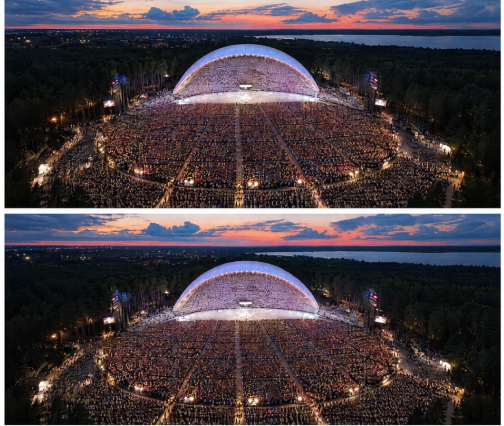
The images invite readers to consider LGBTQ+ people not as a distant or separate group, but as part of the wider Latvian population.
Latvia has a strong cultural tradition of folk songs, including the historic Dainu skapis, a collection of Latvian folk songs. A young boy can learn a wedding song from that collection and sing it at his sister’s wedding.
But what happens when he asks whether she will be allowed to sing the same song at his wedding to another man?
The Latvian phrase “Arī mēs esam tauta” means “We are the Latvian people, too”.
It reflects the central question underlying the country’s ongoing debate over LGBTQ+ rights: whether all citizens, regardless of sexual orientation or gender identity, can enjoy equal recognition, protection and dignity in their own country.
The court cases, parliamentary transcripts, voting records and international comparisons provide a public record against which Latvia’s political commitments can be assessed.
Behind those records are families seeking recognition, children needing legal protection, couples seeking equal marriage rights and public officials responsible for decisions that affect their lives.




Copyright © All right reserved to pahichan.com Site By: Sobij.
