Kathmandu- the Supreme Court has issued a directive order in the name of the Government of Nepal to implement constitutional provisions by amending election-related laws in accordance with the spirit and Article 42 of the Constitution of Nepal. On Monday, a joint bench of Justices Sapana Pradhan Malla and Bal Krishna Dhakal issued the directive order.
Previously, the bench of Supreme Court Justice Sushmalata Mathema had issue a show-cause order on February 16, 2024, and granted priority to the case. Since then, after the case was listed four times but remained “could not be heard”, it was finally decided by a joint bench.
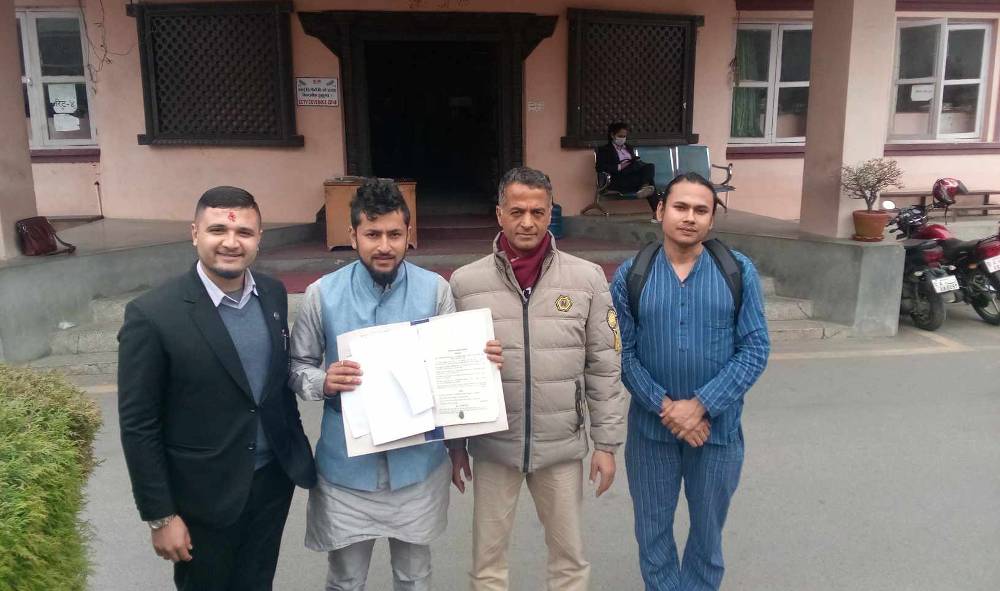
Five individuals, including Mayako Pahichan Nepal’s founding chairperson Maya (Ram Bahadur) Gurung, Vice-chairperson Devendra Bahadur Khatri (Madhu), and Secretary Surendra Pandey, had filed a writ petition on February 14, 2024,seeking a mandamus order. The office of the Prime Minister and Council of Ministers, Federal Parliament Secretariat, Ministry of Law, Justice and Parliamentary Affairs, and the Election Commission were named as defendants in the writ.
The writ stated that the Gender and Sexual Minority (GSM) community has not been able to be represented as people’s representatives through various levels of state elections. Furthermore, it was argued that since the existing Election Commission Act, 2016, House of Representatives Member Election Act, 2017, and other election-related acts failed to include the representation of the petitioners, they are not in a position to compete in direct elections like other citizens.
In the case, senior advocate Kedar Dahal and advocate Raunik Raj Aryal, on behalf of the petitioners, argued that the right to social justice and inclusive representation ensured by Article 42 of the Constitution of Nepal has not been fully implemented through election laws.
They argued that specifically, Schedule-1 of the election law does not include gender and sexual minority (GSM) communities along with some other marginalized and minority communities in the proportional inclusive representation list, asserting that such a provision is contrary to the spirit and essence of the Constitution.
On behalf of the government, the Office of the Attorney General argued that according to the latest national census, the number of persons with “other” gender identity is only 2,928, and since approximately 93,000 votes are required to elect one member of the House of Representatives under the proportional election system, there is no justification for a separate reservation for this community.
During the hearing, Sunil Babu Pant, Executive Director of Mayako Pahichan Nepal, intervened with the court’s permission and clarified that the census data does not represent the actual status of the community.
He stated that due to circumstances where many gender and sexual minority individuals are rejected by families, kicked out of homes, or parents do not wish to disclose their actual gender identity, even the data of third gender and intersex individuals falling under “other” gender identity remains incomplete.
He argued that since the national census did not separately count gay men and lesbians, who exist in relatively larger numbers, the current statistics cannot be considered the basis for the actual population of the entire gender and sexual minority community. Additionally, he shared with the bench that while various global studies show about 8 to 10% of the total population falls under the gender and sexual minority community in some form, Nepal’s census has still failed to capture the community’s true situation.
Pant also presented to the court the fact that the National Statistics Office has already admitted the current census does not reflect the actual situation of the gender and sexual minority community and is preparing to conduct a special study on the actual population and status of this community in the future.
Mayako Pahichan Nepal has stated that it views this Supreme Court order as a significant constitutional achievement towards ensuring inclusive democracy, social justice, and political representation for the gender and sexual minority community in Nepal.
According to Mayako Pahichan Nepal, it is now expected that the Government of Nepal and the Federal Parliament, respecting the Supreme Court’s directive order, will take necessary steps to implement the right to inclusive representation guaranteed by the Constitution by amending the election laws.
Stating that there is a constitutional obligation to ensure that rights guaranteed by the Constitution are not limited to paper but are implemented equally in law, policy, and practice, Mayako Pahichan Nepal mentioned that this directive order from the Supreme Court has reaffirmed that responsibility.
Also: Supreme Court gives priority to writ petition seeking government job, seeks response from government.





Copyright © All right reserved to pahichan.com Site By: Sobij.
