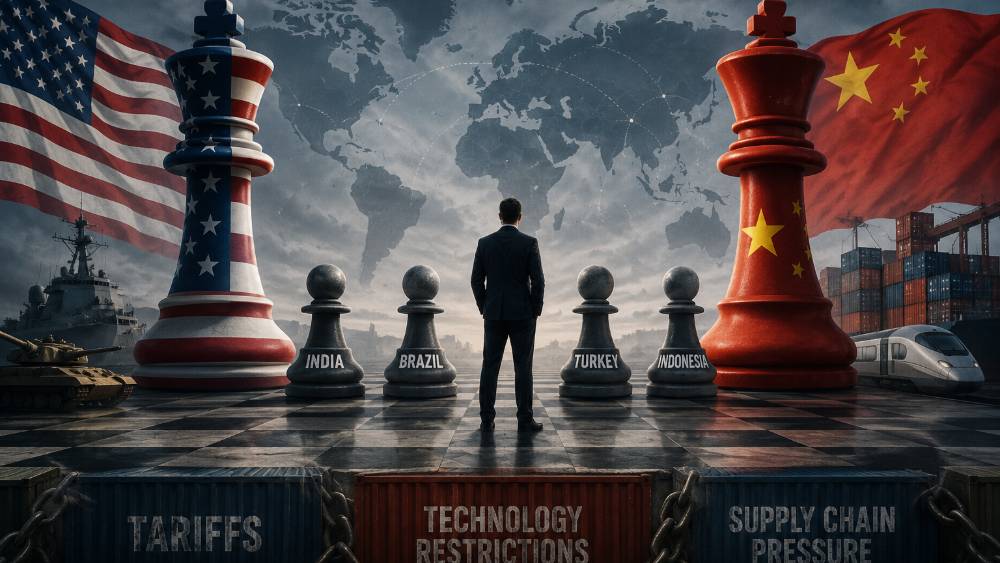
The 21st century is marked by rising rivalry among major powers, often referred to as a “New Cold War.” Unlike the ideological fight of the 20th century, today’s competition focuses more on technology, economic influence, and geopolitical power rather than capitalism versus communism. In this changing environment, middle power states play a critical but often ignored role. These nations, not dominant players but also not insignificant, must navigate a complicated mix of challenges, chances, and limitations as competition among great powers reshapes the global economy.
At its core, the New Cold War is fueled by strategic competition among leading economies striving to control crucial sectors like advanced technology, energy systems, and global supply chains. This rivalry has sparked trade disputes, sanctions, export controls, and competing economic groups. While major powers can absorb shocks and adjust their strategies, middle powers often do not have that flexibility. Consequently, they are more vulnerable to economic instability and political pressure.
The Rise of a New Cold War
The “New Cold War” refers to the post-2014, and particularly post-2022, escalation of tensions between the West ( U.S. and NATO) and a strategic partnership between Russia and China.The “new cold war” is an emerging geopolitical, economic, and ideological competition, primarily between the United States and China, often joined by Russia. Intensifying since the late 2010s, this rivalry involves technology disputes, military maneuvering, and a push for global influence, differing from the original Cold War through deep economic interdependence.
The US–China great power rivalry began to define their relationship after the 2009 global financial crisis. China weathered the crisis more effectively than the United States, bolstering Chinese leaders’ confidence in the country’s rise and reinforcing the belief that the US was in decline. This generated a shift in China’s attitude—from looking up at the United States with a sense of inferiority, to viewing it as an equal, if not from a position of superiority.
As the new Cold War took shape across multiple domains, the Trump administration adopted an ‘all-of-government’ and ‘all-of-society’ approach and launched a trade war to address economic grievances and curtail China’s technological advancement.
Effect of New Cold War:
One of the most noticeable effects on middle powers is the change in global trade and supply chains. Efforts by major economies to lessen dependence on strategic rivals have resulted in fragmented production networks. Policies like “friend-shoring” and “near-shoring” urge companies to move manufacturing to politically aligned countries. For some middle powers, this offers a chance to attract investment and increase exports. However, these benefits are uneven and often come with conditions, such as political alignment and regulatory trade-offs. Countries that cannot position themselves within these new networks risk being pushed aside.
Sanctions and economic pressure add more complexity. As great powers increasingly use economic measures to achieve geopolitical goals, middle powers often suffer collateral damage. For example, sanctions aimed at one country can disrupt trade routes, raise energy prices, and destabilize financial markets worldwide. Middle powers that maintain economic relationships with various blocs face the tough task of balancing these connections without facing penalties. This balancing act is especially difficult for economies that rely heavily on imports, remittances, or external funding.
Another aspect of the economic pressure is technological separation. Competition in fields like semiconductors, artificial intelligence, and telecommunications has led to limits on technology transfer and investment. Many middle powers depend on imported technology, so they must choose between competing systems or try to stay compatible with both. This situation can raise costs, slow innovation, and create long-term dependencies. Furthermore, aligning with one technological system might restrict access to markets or partnerships tied to the other.
Financial systems are becoming battlegrounds as well. Competing financing models, development projects, and lending institutions give middle powers alternative sources of funding but also bring new risks. Access to infrastructure funding or emergency loans can offer short-term relief, but it may come with terms that affect economic independence. Managing these options demands careful diplomacy and long-term planning, as mistakes can lead to debt problems or political entanglements.
Energy markets add another layer of complexity. Changes in energy supply chains—due to sanctions, conflicts, and the shift toward renewable sources—have significant effects on middle powers. Countries that import energy face rising costs and supply uncertainties, while resource-rich nations might gain from higher demand but remain vulnerable to price swings. The move toward green energy places additional pressure, as middle powers need to invest in new technologies even without always having the financial or institutional means to do so effectively.
In response to these challenges, many middle powers are trying to revive or rethink their strategies for independence. Instead of fully aligning with one major power, they aim to diversify partnerships, strengthen regional cooperation, and build domestic resilience. Regional trade agreements, investment in local industries, and efforts to enhance their value-added processes are part of this approach. However, the success of these strategies varies greatly based on governance, economic structure, and geopolitical position.
Conclusion:
In the end, the New Cold War is altering the global economic landscape in ways that mainly impact middle power states. While great powers dictate the rules of competition, middle powers must operate within those constraints, often with limited freedom. Their challenge is not just to survive this time of increased rivalry but also to find ways to turn it into opportunities for sustainable growth and development.
The stakes are high. If handled well, the changing environment could create new paths for industrialization and economic diversification. If mismanaged, it could deepen inequalities, increase dependency, and weaken sovereignty. In this uncertain period, the future of middle powers will rely on their ability to blend pragmatism with strategic foresight—transforming limitations into chances without sacrificing their autonomy.




Copyright © All right reserved to pahichan.com Site By: Sobij.
